Wednesday, March 2, 2016

Tuesday, February 23, 2016
Tuesday, February 16, 2016
Friday, February 5, 2016
Wednesday, February 3, 2016
Thursday, November 19, 2015
Graphene as a front contact for silicon-perovskite tandem solar cells
Team develops elegant process for coating fragile perovskite layers with graphene for the first time
The perovskite film (black, 200-300 nm) is covered by Spiro.OMeTAD, Graphene with gold contact at one edge, a glass substrate and an amorphous/crystalline silicon solar cell.
Credit: F. Lang / HZB
Silicon absorbers primarily convert the red portion of the solar spectrum very effectively into electrical energy, whereas the blue portions are partially lost as heat. To reduce this loss, the silicon cell can be combined with an additional solar cell that primarily converts the blue portions.
Teams at HZB have already acquired extensive experience with these kinds of tandem cells. A particularly effective complement to conventional silicon is the hybrid material called perovskite. It has a band gap of 1.6 electron volts with organic as well as inorganic components. However, it is very difficult to provide the perovskite layer with a transparent front contact. While sputter deposition of indium tin oxide (ITO) is common practice for inorganic silicon solar cells, this technique destroys the organic components of a perovskite cell.
Graphene as transparent front contact:
Now a group headed by Prof. Norbert Nickel has introduced a new solution. Dr. Marc Gluba and PhD student Felix Lang have developed a process to cover the perovskite layer evenly with graphene. Graphene consists of carbon atoms that have arranged themselves into a two-dimensional honeycomb lattice forming an extremely thin film that is highly conductive and highly transparent.Fishing for graphene:
As a first step, the scientists promote growth of the graphene onto copper foil from a methane atmosphere at about 1000 degrees Celsius. For the subsequent steps, they stabilise the fragile layer with a polymer that protects the graphene from cracking. In the following step, Felix Lang etches away the copper foil. This enables him to transfer the protected graphene film onto the perovskite. "This is normally carried out in water. The graphene film floats on the surface and is fished out by the solar cell, so to speak. However, in this case this technique does not work, because the performance of the perovskite degrades with moisture. Therefore we had to find another liquid that does not attack perovskite, yet is as similar to water as possible," explains Gluba.Ideal front contact:
Subsequent measurements showed that the graphene layer is an ideal front contact in several respects. Thanks to its high transparency, none of the sunlight's energy is lost in this layer. But the main advantage is that there are no open-circuit voltage losses, that are commonly observed for sputtered ITO layers. This increases the overall conversion efficiency. "This solution is comparatively simple and inexpensive to implement," says Nickel. "For the first time, we have succeeded in implementing graphene in a perovskite solar cell. This enabled us to build a high-efficiency tandem device."Source by: http://www.sciencedaily.com/releases/2015/10/151002113551.htm
Wednesday, November 18, 2015
Record High Performance With New Solar Cells

Researchers are reporting record-high efficiency levels for a new generation of solar cells.
Credit: National Renewable Energy Lab
Researchers in China and Switzerland are reporting the highest efficiency ever for a promising new genre of solar cells, which many scientists think offer the best hope for making the sun a mainstay source of energy in the future. The photovoltaic cells, called dye-sensitized solar cells or Grätzel cells, could expand the use of solar energy for homes, businesses, and other practical applications, the scientists say.
The research, conducted by Peng Wang and colleagues — who include Michael Grätzel, inventor of the first dye-sensitized solar cell — involves photovoltaic cells composed of titanium dioxide and powerful light-harvesting dyes. Grätzel cells are less expensive than standard silicon-based solar cells and can be made into flexible sheets or coatings.
Although promising, Grätzel cells until now have had serious drawbacks. They have not been efficient enough at converting light into electricity. And their performance dropped after relatively short exposures to sunlight.
In the new study, researchers describe lab tests of solar cells made with a new type of ruthenium-based dye that helps boost the light-harvesting ability. The new cells showed efficiencies as high as 10 percent, a record for this type of solar cell. The new cells also showed greater stability at high temperatures than previous formulas, retaining more than 90 percent of their initial output after 1,000 hours in full sunlight.
Source by: http://www.sciencedaily.com/releases/2008/11/081103124224.htm
Tuesday, November 17, 2015
Breakthrough for iron based dyes can lead to cheaper and environmentally friendly solar energy applications
Researchers at Lund University in Sweden have found a new way to capture energy from sunlight -- by using molecules that contain iron. The results are presented in the latest issue of Nature Chemistry. The hope is to develop efficient and environmentally friendly solar energy applications.
Solar energy is an inexhaustible resource that we currently only utilise to a very limited extent. Researchers around the world are therefore trying to find new and more efficient ways to use the energy in sunlight.
The technique the researchers in Lund are working on is solar cells consisting of a thin film of nanostructured titanium dioxide and a dye that captures solar energy. Today, the best solar cells of this type use dyes containing ruthenium metal -- a very rare and expensive element.
"Many researchers have tried to replace ruthenium with iron, but without success. All previous attempts have resulted in molecules that convert light energy into heat instead of electrons, which is required for solar cells to generate electricity," says Villy Sundström, Professor of Chemical Physics at Lund University.
Researchers at the Chemistry Department in Lund, in collaboration with Uppsala University, have now successfully produced an iron-based dye that is capable of converting light into electrons with nearly 100 per cent efficiency.
"The advantage of using iron is that it is a common element in nature. It can provide inexpensive and environmentally friendly applications of solar energy in the future," says Kenneth Wärnmark, Professor of Organic Chemistry at Lund University.
By combining the experiments with advanced computer simulations, the researchers are able to understand in detail required design concepts for the iron molecules to work. This knowledge is now being used for further developing the iron-based dyes. More research is needed before the new solar cell dye can be used in practice, but there are high hopes.
"The results of the study suggest that solar cells based on these materials can be at least as effective as those of today that are based on ruthenium or other rare metals," says Villy Sundström.
The discovery could also advance research on solar fuels in which, like in photosynthesis of plants, water and carbon dioxide are turned into energy-rich molecules -- solar fuel -- with the help of sunlight.
"We envision that the new iron-based molecules could also drive the chemical reactions that create solar fuel," says Kenneth Wärnmark.
The researchers have worked on developing iron-based solar cell dyes for three years and are surprised by how quickly they found a dye that can capture sunlight as efficiently as this.
"Achieving success in research usually takes longer than what we hope for and believe," says Villy Sundström and continues: "For once, it was the opposite!."
Source by: http://www.sciencedaily.com/releases/2015/10/151013112359.htm
Sunday, November 15, 2015
Solar vehicle charging at home

An electric vehicle is charged with photovoltaic power from the roof of the house using a charging station.
Credit: © Fraunhofer ISE
Owners of home photovoltaic systems will soon be able to make their households even more sustainable, because PV power is also suitable for charging personal electronic vehicles. A home energy management system created by Fraunhofer researchers incorporates electric vehicles into the household energy network and creates charging itineraries.
The house of the future is environmentally friendly, energy efficient and smart. Its inhabitants can utilize rooftop-generated PV energy not only for household consumption but also to charge their personal electric vehicle. This scenario has already become reality for a collection of row houses built according to the "Passive House" standard in the German city of Fellbach in Baden-Württemberg. The group of new homes was upgraded as part of the "Fellbach ZeroPlus" project to include electromobility enhancements as well as a comprehensive energy management system. The initiative is sponsored by the German Federal Government's "Electric Mobility Showcase" program.
Fast charging stations and home energy management
"The large photovoltaic systems on the rooftops of the houses provide more power than the inhabitants consume over the long term. Surplus power can be fed into the public grid as well as be used for charging the household electric vehicle," explains Dominik Noeren, a scientist at the Fraunhofer Institute for Solar Energy Systems ISE in Freiburg. To efficiently incorporate electromobility enhancements into the daily routines of the households, Noeren and his team designed a 22 kW fast charging station as well as a home energy management system (HEMS) for five of the seven homes. The Java-based HEMS software runs on small computers known as embedded systems. The HEMS collects data from the various electricity meters in the house, including those for the photovoltaic system, the electric vehicle, the heat pump, and general household power. The system displays the various power flows and informs the homeowners about their current power consumption at any time of the day. "They can see how much power is coming from either the public grid or the household solar system, and they can see where it is going -- to the heat pump, household appliances, or the electric vehicle," says Noeren.
Furthermore, the HEMS also forecasts solar intensity over the next 20 hours or so and provides users with information on how much solar power is available. An adaptive algorithm also computes anticipated household power loads for each quarter hour. Using this data, it is possible to determine how much PV power is available for the electric vehicle at any given time. "Electricity from the PV first goes to the house, and power that is not consumed there is stored in the electric vehicle battery. If there is still any electricity left over after that, it is fed into the public electricity grid," explains Noeren.
During two years of field testing, an Android application was created using feedback from the homeowners. The HEMS app provides a visualization of all processes and electricity flows in real time, and gives solar intensity forecast readouts in graphical and numerical form. An adaptive algorithm works to optimize the use of the power generated by each household. Through the app, users can control the charging station as well as view the battery charge level and charging times of the electric vehicle. "These parameters are necessary in order to intelligently charge the electric vehicle," says Noeren.
To create an ideal charging itinerary, the system must know the vehicle's current battery charge level as well as its next planned departure time. The energy management system uses this information together with weather and consumption forecasts to estimate the flows through the household power network. It calculates how much electricity must be topped up, as well as which time periods are ideal for recharging the vehicle using the greatest possible proportion of household-produced solar energy.
"It is more cost effective to consume the self-generated solar electricity than to feed it into the public electricity grid," says Noeren. The HEMS system helps consumers use data on driving times, solar intensity forecasts and current household energy consumption to synchronize electric vehicle charging times with rooftop energy production, so they can maximize the proportion of household-produced energy they use. This not only helps homeowners lower their costs, but it also goes a step closer towards realizing the ideal of low-CO2 homes and personal mobility. Maximizing the proportion of household-produced energy consumed helps unburden the public power grid while reducing household feed-in peaks to the grid.
The HEMS system is based on the Fraunhofer openMUC framework, which supports a wide variety of meters and devices. It offers modular expandability for integrating devices such as wireless Bluetooth or WLAN power outlets that can remotely activate and deactivate household appliances, or for integrating high-consumption items such as heat pumps. Two of the five households in the "Fellbach ZeroPlus" project have been successfully using a car-sharing variant of the system as part of a field test since mid-2014.
Source by: http://www.sciencedaily.com/releases/2015/11/151104130050.htm
Friday, November 13, 2015
Greener' way to assemble materials for solar applications

A surfactant template guides the self-assembly of functional polymer structures in an aqueous solution.
Credit: Image credit: Oak Ridge National Laboratory, U.S. Dept. of Energy; image by Youngkyu Han and Renee Manning.
The efficiency of solar cells depends on precise engineering of polymers that assemble into films 1,000 times thinner than a human hair.
Today, formation of that polymer assembly requires solvents that can harm the environment, but scientists at the Department of Energy's Oak Ridge National Laboratory have found a "greener" way to control the assembly of photovoltaic polymers in water using a surfactant-- a detergent-like molecule--as a template. Their findings are reported in Nanoscale, a journal of the Royal Society of Chemistry.
"Self-assembly of polymers using surfactants provides huge potential in fabricating nanostructures with molecular-level controllability," said senior author Changwoo Do, a researcher at ORNL's Spallation Neutron Source (SNS).
The researchers used three DOE Office of Science User Facilities--the Center for Nanophase Materials Sciences (CNMS) and SNS at ORNL and the Advanced Photon Source (APS) at Argonne National Laboratory--to synthesize and characterize the polymers.
"Scattering of neutrons and X-rays is a perfect method to investigate these structures," said Do.
The study demonstrates the value of tracking molecular dynamics with both neutrons and optical probes.
"We would like to create very specific polymer stacking in solution and translate that into thin films where flawless, defect-free polymer assemblies would enable fast transport of electric charges for photovoltaic applications," said Ilia Ivanov, a researcher at CNMS and a corresponding author with Do. "We demonstrated that this can be accomplished through understanding of kinetic and thermodynamic mechanisms controlling the polymer aggregation."
The accomplishment creates molecular building blocks for the design of optoelectronic and sensory materials. It entailed design of a semiconducting polymer with a hydrophobic ("water-fearing") backbone and hydrophilic ("water-loving") side chains. The water-soluble side-chains could allow "green" processing if the effort produced a polymer that could self-assemble into an organic photovoltaic material. The researchers added the polymer to an aqueous solution containing a surfactant molecule that also has hydrophobic and hydrophilic ends. Depending on temperature and concentration, the surfactant self-assembles into different templates that guide the polymer to pack into different nanoscale shapes--hexagons, spherical micelles and sheets.
In the semiconducting polymer, atoms are organized to share electrons easily. The work provides insight into the different structural phases of the polymer system and the growth of assemblies of repeating shapes to form functional crystals. These crystals form the basis of the photovoltaic thin films that provide power in environments as demanding as deserts and outer space.
"Rationally encoding molecular interactions to rule the molecular geometry and inter-molecular packing order in a solution of conjugated polymers is long desired in optoelectronics and nanotechnology," said the paper's first author, postdoctoral fellow Jiahua Zhu. "The development is essentially hindered by the difficulty of in situ characterization."
In situ, or "on site," measurements are taken while a phenomenon (such as a change in molecular morphology) is occurring. They contrast with measurements taken after isolating the material from the system where the phenomenon was seen or changing the test conditions under which the phenomenon was first observed. The team developed a test chamber that allows them to use optical probes while changes occur.
Neutrons can probe structures in solutions
Expertise and equipment at SNS, which provides the most intense pulsed neutron beams in the world, made it possible to discover that a functional photovoltaic polymer could self-assemble in an environmentally benign solvent. The efficacy of the neutron scattering was enhanced, in turn, by a technique called selective deuteration, in which specific hydrogen atoms in the polymers are replaced by heavier atoms of deuterium--which has the effect of heightening contrasts in the structure. CNMS has a specialty in the latter technique.
"We needed to be able to see what's happening to these molecules as they evolve in time from some solution state to some solid state," author Bobby Sumpter of CNMS said. "This is very difficult to do, but for molecules like polymers and biomolecules, neutrons are some of the best probes you can imagine." The information they provide guides design of advanced materials.
By combining expertise in topics including neutron scattering, high-throughput data analysis, theory, modeling and simulation, the scientists developed a test chamber for monitoring phase transitions as they happened. It tracks molecules under conditions of changing temperature, pressure, humidity, light, solvent composition and the like, allowing researchers to assess how working materials change over time and aiding efforts to improve their performance.
Scientists place a sample in the chamber and transport it to different instruments for measurements. The chamber has a transparent face to allow entry of laser beams to probe materials. Probing modes--including photons, electrical charge, magnetic spin and calculations aided by high-performance computing--can operate simultaneously to characterize matter under a broad range of conditions. The chamber is designed to make it possible, in the future, to use neutrons and X-rays as additional and complementary probes.
"Incorporation of in situ techniques brings information on kinetic and thermodynamic aspects of materials transformations in solutions and thin films in which structure is measured simultaneously with their changing optoelectronic functionality," Ivanov said. "It also opens an opportunity to study fully assembled photovoltaic cells as well as metastable structures, which may lead to unique features of future functional materials."
Whereas the current study examined phase transitions (i.e., metastable states and chemical reactions) at increasing temperatures, the next in situ diagnostics will characterize them at high pressure. Moreover, the researchers will implement neural networks to analyze complex nonlinear processes with multiple feedbacks.
The title of the Nanoscale paper is "Controlling molecular ordering in solution-state conjugated polymers."
Source by: http://www.sciencedaily.com/releases/2015/10/151005163040.htm
Monday, November 9, 2015
How trillions of tiny solar panels could power the internet of things
It could herald a great leap forward in the way we live our lives. The internet of things, the idea that objects can be interconnected via a global network, will run your home, keep you healthy and even check how much food is in your fridge. It will mean a trillion new “smart sensors” being installed around the world by 2020. But what’s going to power these devices?
In some cases, the energy source is obvious: sensors in fridges or traffic lights can simply tap into mains electricity. But it’s much trickier to power something that detects water quality in remote reservoirs, cracks in railway lines, or whether a farmer’s cows are happy and healthy.
Organic solar panels might be the answer. They’re cheap, and are flexible enough to power minuscule sensors whatever their shape. The cells can be just two micrometres thick – around a 50th the width of a human hair – but they are able to absorb a huge amount of light for such a thin surface.
These organic photovoltaics (OPVs) differ from silicon solar cells as they can be made entirely from specially-synthesised organic materials, which are deposited onto cheap substrates such as PET, a form of polyester also used in soft drink bottles and crisp packets. This material is lighter, more flexible and can even be tuned to provide different colours – who said solar cells have to be plain black?

Critically, it takes just one day for OPVs to earn back the energy invested in their manufacture, known as the “energy payback time”, which compares to around one to two years for regular silicon solar cells.
Organic photovoltaics can also be moulded onto 3-D surfaces such as roof tiling or even clothing. In our latest research, colleagues and I demonstrated that this makes them more effective at capturing diffuse or slanting light. This wouldn’t make much difference for a regular solar farm in a sunny country, but cloudier places at higher latitudes would see benefits.
For the internet of things, however, these improvements are a game-changer. Few of those trillion sensors will be placed conveniently in the sunshine, facing upwards; far more will be in unusual locations where light only falls indirectly. Tiny organic solar cells will enable energy to be captured throughout the day, even indoors or when attached to clothes.
From billions to a trillion
There’s no denying the huge need for such a technology. The “trillion sensors” figure at first seems outlandish, but consider the fact that a typical smartphone, for example, possesses around ten smart sensors that measure light, temperature, sound, touch, movement, position, humidity and more. More than a billion smartphones will be sold this year, so that’s 10 billion new sensors just in phones. And not all smart sensors are confined to smartphones, of course; they are already routinely used in personal care, environmental monitoring, security and transport.
Whatever the exact numbers, we can assume that many, many more sensors will be deployed in future and their complexity and usefulness is growing exponentially. My colleagues and I at Bangor are interested in how we could power them all, which is what led us to organic solar.

Though engineers will always try to reduce energy consumption through better design and putting sensors to “sleep” when they are not required, even ultra-low power sensors still consume around 3.5mW (milliWatts) per measurement. Poorer quality sensors might use considerably more.
Now assuming the “average” sensor actually consumes 5mW per measurement, and assuming one measurement is made every minute and takes 30 seconds to complete, this average smart sensor will need 22 Wh (watt-hours) in a calendar year. On it’s own, this is not a substantial value and equivalent to running your TV for about five minutes.
But it all adds up. Based on this simple analysis, 1 trillion sensors will use 21,900 Gigawatt hours (GWh) per year. That’s an incredible demand on electricity grids, equivalent to the combined output from a few typical nuclear power plants. This is all before considering the extra demand needed by data centres to handle and store such large sums of information.

Yes, low-power electronics will be developed that should reduce the amount of energy that the sensors need. But, for long term operation, many sensors can’t rely upon an internal battery, as a battery has a finite energy store. This is particularly pertinent as many smart sensors may be placed in remote locations, often far from the electricity grid or without a power connection.
Therefore we must create smart sensors that can harvest their own energy from the local environment – and it’s here that organic solar technology will find its niche.
Source by: http://theconversation.com/how-trillions-of-tiny-solar-panels-could-power-the-internet-of-things-50023
Thursday, November 5, 2015
Shining more light on solar panels
Improving low concentration photovoltaics
Thermal radiation readings on panels help Joshua Pearce and his research team better understand ways to improve low-concentration photovoltaic systems.
Credit: Joshua Pearce, Michigan Tech
Solar panels are the beacon of renewable energy, yet they are not getting as much light as they could be. Joshua Pearce from Michigan Technological University and a team from Queen's University in Canada have found a way to get more sun to shine on the panels and crank up the output by 30 percent or more.
"We expend a lot of blood, sweat and tears to make solar panels as efficient as possible," Pearce says. "We work so hard to get a fraction of a percent increase on the module level; double digit returns on the systems level was relatively easy."
Such a large increase of efficiency at the system level then could greatly change how solar panels are installed, and with the economic payback, it could even mean major retrofits for existing solar farms.
"We're looking at this from a systems perspective," Pearce says, who is an associate professor of materials science and engineering and electrical and computing engineering. He explains that the research focused on the system rather than individual panels mostly because the current set up for ground-mounted solar panel arrays is "wasting space."
The iconic flat-faced solar panels installed in large-scale utility solar farms are spaced apart to prevent shading. As the sun shines on a photovoltaic system, sending electricity into the grid, a fair amount of that potential energy is lost as the light hits the ground between rows of panels. The solution is simple, says Pearce: Fill the space with a reflector to bounce sunlight back onto the panels and use the light-reflecting mathematical models of videogames and action movies to avoid temperature swings.
Source by: http://www.sciencedaily.com/releases/2015/10/151022141718.htm
Tuesday, November 3, 2015
Storage advance may boost solar thermal energy potential

An advance in the storage of concentrated solar thermal energy may reduce reduce its cost and make it more practical for wider use.
Credit: Graphic by Kelvin Randhir, courtesy of the University of Florida
Engineers at Oregon State University have identified a new approach for the storage of concentrated solar thermal energy, to reduce its cost and make it more practical for wider use.
The advance is based on a new innovation with thermochemical storage, in which chemical transformation is used in repeated cycles to hold heat, use it to drive turbines, and then be re-heated to continue the cycle. Most commonly this might be done over a 24-hour period, with variable levels of solar-powered electricity available at any time of day, as dictated by demand.
The findings have been published in ChemSusChem, a professional journal covering sustainable chemistry. The work was supported by the SunShot Initiative of the U.S. Department of Energy, and done in collaboration with researchers at the University of Florida.
Conceptually, all of the energy produced could be stored indefinitely and used later when the electricity is most needed. Alternatively, some energy could be used immediately and the rest stored for later use.
Storage of this type helps to solve one of the key factors limiting the wider use of solar energy -- by eliminating the need to use the electricity immediately. The underlying power source is based on production that varies enormously, not just night and day, but some days, or times of day, that solar intensity is more or less powerful. Many alternative energy systems are constrained by this lack of dependability and consistent energy flow.
Solar thermal electricity has been of considerable interest because of its potential to lower costs. In contrast to conventional solar photovoltaic cells that produce electricity directly from sunlight, solar thermal generation of energy is developed as a large power plant in which acres of mirrors precisely reflect sunlight onto a solar receiver. That energy has been used to heat a fluid that in turn drives a turbine to produce electricity.
Such technology is appealing because it's safe, long-lasting, friendly to the environment and produces no greenhouse gas emissions. Cost, dependability and efficiency have been the primary constraints.
"With the compounds we're studying, there's significant potential to lower costs and increase efficiency," said Nick AuYeung, an assistant professor of chemical engineering in the OSU College of Engineering, corresponding author on this study, and an expert in novel applications and use of sustainable energy.
"In these types of systems, energy efficiency is closely related to use of the highest temperatures possible," AuYeung said. "The molten salts now being used to store solar thermal energy can only work at about 600 degrees centigrade, and also require large containers and corrosive materials. The compound we're studying can be used at up to 1,200 degrees, and might be twice as efficient as existing systems.
"This has the potential for a real breakthrough in energy storage," he said.
According to AuYeung, thermochemical storage resembles a battery, in which chemical bonds are used to store and release energy -- but in this case, the transfer is based on heat, not electricity.
The system hinges on the reversible decomposition of strontium carbonate into strontium oxide and carbon dioxide, which consumes thermal energy. During discharge, the recombination of strontium oxide and carbon dioxide releases the stored heat. These materials are nonflammable, readily available and environmentally safe.
In comparison to existing approaches, the new system could also allow a 10-fold increase in energy density -- it's physically much smaller and would be cheaper to build.
The proposed system would work at such high temperatures that it could first be used to directly heat air which would drive a turbine to produce electricity, and then residual heat could be used to make steam to drive yet another turbine.
In laboratory tests, one concern arose when the energy storage capacity of the process declined after 45 heating and cooling cycles, due to some changes in the underlying materials. Further research will be needed to identify ways to reprocess the materials or significantly extend the number of cycles that could be performed before any reprocessing was needed, AuYeung said.
Other refinements may also be necessary to test the system at larger scales and resolve issues such as thermal shocks, he said, before a prototype could be ready for testing at a national laboratory.
Source by: http://www.sciencedaily.com/releases/2015/11/151103140440.htm
Sunday, November 1, 2015
MAKING LIGHT WITH RECYCLED PLASTIC BOTTLES
How It Works?
The plastic bottle is filled with only water and bleach. The liquid inside the bottle harnesses the light from the sun, capturing and diffracting the light to all parts of the room. It is equivalent to a 55 watt light bulb.
What's the Technology?

It consists of a 1.5l PET bottle filled with purified water and bleach (10 ml). A special glue is used to bond and seal the bottle to the roof. Adding the bleach to the water makes sure that the water stays clean and transparent without algae growing inside and turning the water green..
Source by: http://www.literoflightswitzerland.org/idea.php?l=en
Saturday, October 31, 2015
A Fix for Maximizing Energy from Solar Panels on Slanted Roofs
Researchers have shown a new way to help solar cells track the sun as it moves across the sky, which could boost a panel’s energy generation by 40 percent.
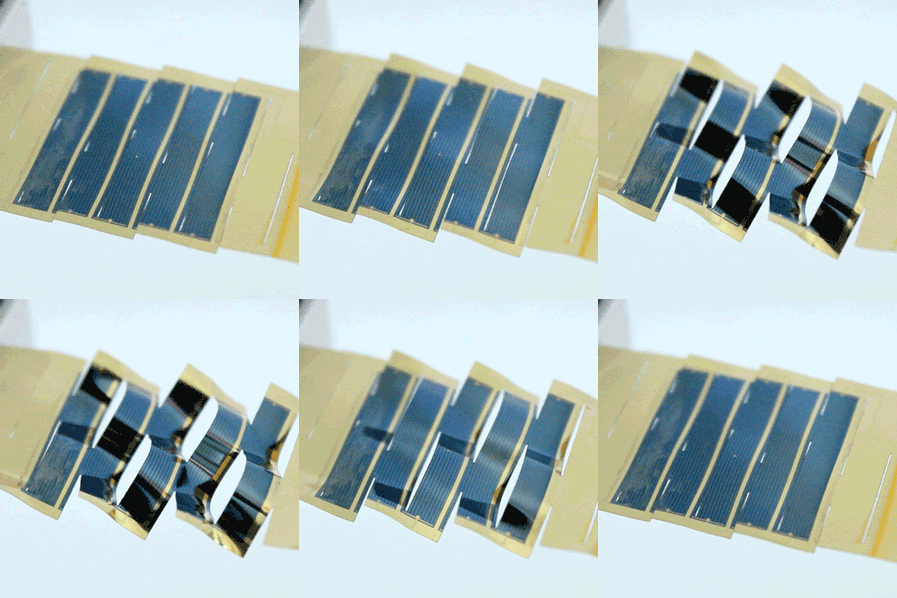
Most of the solar panels in the world sit on rooftops at a fixed angle, so they miss out on capturing energy during parts of every day. Now researchers have shown that by cutting solar cells into specific designs using kirigami, a variation of origami which entails cutting in addition to folding, they can allow the cells to track the sun’s angle without having to tilt the whole panel. This could have a substantial payoff: solar panels with tracking mechanisms can generate 20 to 40 percent more energy per year than those without trackers.
As shown in the video here, applying a specific kirigami cut creates strips in a solar cell. Pulling the two ends in opposite directions causes the strips to tilt and assume a desired angle. Crucially, the structure morphs in such a way that prevents the individual strips from casting shadows on the others, and the “waviness” of the new form does not detract from performance, says Max Shtein, a professor of materials science and engineering at the University of Michigan. Shtein led the research along with Stephen Forrest, also a professor of materials science and engineering at the University of Michigan.
The kirigami-based approach makes it possible to generate more electricity while using the same amount of semiconducting material, and accomplishes this to nearly the same degree that conventional tracking systems do, says Shtein. Today’s tracking systems, featured in only a small portion of the world’s solar power installations, are cumbersome and can be costly. And they function by tilting the whole panel. That doesn’t work on most pitched rooftop systems, which account for more than 80 percent of all installations.
The newly demonstrated device, which features flexible solar cells made of gallium arsenide, is only a proof-of-principle. Developing a technology practical enough for commercial application will take a lot more work. The researchers will likely need to come up with a system for encasing the structures to protect them against the weather and provide mechanical support, and may add electric motors to pull the cells apart at specific times during the day. “It doesn’t take much force at all,” says Shtein. He says that although the approach is best suited for thin, flexible materials, in principle it could work with “almost any kind of solar cell.”
Source by: http://www.technologyreview.com/news/541191/a-fix-for-maximizing-energy-from-solar-panels-on-slanted-roofs/
Thursday, October 29, 2015
‘Railway Solar’ May Be a Sweet Spot for Green Transportation

With climate considerations becoming more important in infrastructure development, train travel and other alternatives to petroleum-powered cars have a renewed relevance.
Trains are far more efficient and less polluting than most cars. In research for my new company focused on providing solar power to electric trains, I’ve been pleasantly surprised at learning how efficient this transportation mode can really be.
Electric trains are 50 percent to 75 percent less polluting than single-passenger cars and trucks and use comparably less energy per passenger-mile, according to a 2009 detailed analysis by Chester and Horvath.
The emissions profile depends a lot, of course, on the grid mix of electricity. Some grids, like in California, the Pacific Northwest and New England, are fairly clean already due to a mix of hydropower, wind, solar, geothermal, nuclear and natural gas.
And over time, these grids are becoming cleaner. California, for example, now has a 50 percent mandate for renewable electricity by 2030. Regular cars are also becoming cleaner due to market forces and increasing fuel-efficiency requirements (CAFE) at the federal level, so the ratios may change a bit with time.
FIGURE 1: Greenhouse Gas Emissions of Various Transportation Modes

I’ve written previously about the problem posed by China and other developing nations wanting to join the Western model of widespread individual car ownership. Car ownership per capita in China, for example, is one-eighth what it is in the U.S. and far less than that in India.
Even if all of the billions of new cars in the world in the coming decades are electric vehicles and are relatively low-polluting, there will still be many issues relating to resource constraints and congestion, as well as higher-than-necessary emissions from what is inherently a less-efficient transportation mode than mass transit.
One readily available alternative to the private vehicle ownership model is to make public transportation so good that people will choose to take a train rather than drive, or to forgo private car ownership even if they could afford one or more of their own cars. This model is becoming a reality with the rapid growth of electric-train systems around the world, particularly in Asia.
For example, Chinese electric train systems have more than doubled in size over the last decade and are now at almost 70,000 miles of track, by far the biggest in the world. India is in second place, with about 40,000 miles of track and growing.
Electric trains are a type of electric vehicle (EV). This may seem to be an obvious point, but the discussion of EVs here at GTM and elsewhere rarely includes electric trains under this rubric. I’ve been guilty of this omission myself despite my longstanding love of trains, electric or otherwise. As EVs, electric trains can be more or less polluting based on the grid mix from which they draw power, as with EVs more generally.
My recent article rebutting a working paper on the environmental impacts of EVs highlighted the fact that the location of EVs matters a lot. If the EV at issue is powered entirely with local renewable energy, the whole system is almost emissions-free: the true sweet spot for global transportation.
For a personal EV, solar on home rooftops can power most families’ car travel needs. The equivalent for electric trains is what I call “railway solar”: putting solar on train station rooftops, parking lots and on solar canopies over or adjacent to the train tracks themselves.
Electric trains are so efficient that a single 300-watt solar panel (about 4x6 feet) can provide up to 7,000 miles of an individual’s commuting miles per year, or 5 to 20 miles per day. The national average, based on National Transportation Database data on the efficiency of the various U.S. electric train systems, is about 4,000 miles per year for each 300-watt solar panel. One mile of train tracks can support 1 megawatts to 3 megawatts of solar panels, which can provide 2 million and 6 million passenger-miles of train travel. Yes, million.
The passenger-miles provided by solar or other renewables is practically emissions-free, even if we include the energy costs required to manufacture and ship the panels.
FIGURE 2: Miles of Daily Train Travel per 300-Watt Solar Panel

Source: NTD data and NREL insolation data
These numbers highlight just how efficient electric trains can be. The equivalent miles from one 300-watt solar panel for a regular electric car -- my tiny Fiat 500e, for example -- would be just 1,600 miles per year, or about 40 percent of the national average for U.S. electric trains. So electric trains are about 2.5 times more efficient than most personal EVs, which are in turn about 2.5 to 3 times more efficient than a highly efficient internal-combustion engine.
Here's another way of looking at it: my Fiat could carry the equivalent of about one 300-watt panel on its upper surface, which would provide just 4.5 miles per day of driving, or 1,643 miles per year. That same panel would provide on average 4,000 passenger-miles per year. There is enough space in the existing rail infrastructure -- on train stations and near train tracks -- for enough solar panels to provide all of the electric train’s power demand.
These numbers translate to the ability to supply a majority or even all of U.S. electric train systems from solar power. For example, Chicago’s Metra Electric line (one of the busiest metro systems in the country) is 31 miles in length. If just 18 of those 31 miles were covered in solar at 1 megawatt per mile, these panels, taking into account the solar radiation in the Chicago area, could supply 100 percent of that line’s electric needs each year.
Other renewables
Wind power is another obvious option for powering electric trains with on-site renewables -- where there are strong wind resources. Distributed wind has not taken off in the U.S. anywhere near to the degree that distributed solar has, but it could be a viable option in many circumstances, particularly where there are state rebates to offset the cost of wind turbines. Wind power in desirable locations is still cheaper than power from solar panels, and can also complement solar power by producing power at night.
Biomass power is also somewhat modular, but highly dependent on feedstock. Dairy gas in California’s Central Valley, for example, could supply a significant amount of the electricity demand for the planned high-speed rail project.
Challenges facing electric trains
Nothing is perfect, and electric trains do have some downsides. We’ve seen many of these downsides highlighted in the debate over the California High-Speed Rail project, which is now under construction after years of delays.
High-speed trains are almost always electric because of the power and efficiency that electric trains offer. A notable exception to this rule can be found with the proposed coastal portion of the California HSR. Due to aesthetic concerns over the catenary lines of electric high-speed trains, the current plan is to make this portion, eventually going through my hometown of Santa Barbara, traditional diesel rather than electric.
Train tracks can require a lot of land, and there are certainly areas where people are hostile to giving up land for new trains, even with fair market compensation. This is partly why the costs of California’s high-speed train have ballooned from initial estimates: the cost of acquiring land for new trains, and the legal battles that follow, can be prohibitive. This is not a problem, however, when we’re dealing with existing train systems, since those battles have been fought and resolved. Efforts to solarize train systems should focus on existing rail rather than new rail systems.
Trains can be noisy, particularly high-speed trains, because they are traveling at such high speeds (upward of 200 miles an hour in many cases). One cool feature of solar canopies over train tracks, however, is that they can include noise-reduction features by enclosing one or both sides of the train with transparent glass. Even better, a number of companies are now working on very thin solar films that coat glass and can actually produce power while still allowing all visible light to go through. In such a case, noise-reduction glass could increase solar power production further, but with additional cost.
Speaking of cost, railway solar canopies will require increased costs in terms of additional support structure and engineering that is specific to the electric-train market. Solar carports are pretty comparable, but they are not as tall and don’t need to be as robust as railway solar canopies. We can expect, however, that the larger scales made possible with railway solar canopies (1 megawatts to 3 megawatts per mile of track) could cut back much of the increased cost of structural support and engineering due to economies of scale.
Is the future going to include significant amounts of solarized electric trains? Given current trends for solar panel prices and the dramatic growth of electric trains around the world, it does seem likely, purely from an economic point of view. When we add in the environmental and other benefits from solarizing electric trains, it becomes even more likely.
My last column looked at the potential for the hyperloop concept championed by Elon Musk and others inspired by his vision. I concluded that the concept has tremendous promise but that the cost of actual projects is a challenging factor. We’ll have to wait and see how real-world costs pan out as actual hyperloop projects start to get built.
Railway solar has very wide applicability even if hyperloops catch on. This is the case because hyperloops are by their nature appropriate for longer distance travel rather than commuter or light rail lines, which are the sweet spot for solar trains. Long-distance high-speed rail can and should be solarized, but if hyperloops end up displacing planned and/or actual high-speed trains, then solarized hyperloops ensure that renewables still power our transportation future.
My preferred future looks something like this: a network of solar-powered hyperloops connecting cities around the world; solar-powered commuter and light rail in each of those cities; and self-driving electric cars, ferrying people to and from train stations and hyperloop stops.
And, of course, those electric cars will also be powered primarily from solar and other renewables, either on peoples’ homes or from the ultra-clean power grid of the future.
Source by: https://www.greentechmedia.com/articles/read/railway-solar-may-be-a-sweet-spot-for-green-transportation
Subscribe to:
Posts (Atom)