Showing posts with label solar. Show all posts

Monday, November 9, 2015

How trillions of tiny solar panels could power the internet of things


It could herald a great leap forward in the way we live our lives. The internet of things, the idea that objects can be interconnected via a global network, will run your home, keep you healthy and even check how much food is in your fridge. It will mean a trillion new “smart sensors” being installed around the world by 2020. But what’s going to power these devices?

In some cases, the energy source is obvious: sensors in fridges or traffic lights can simply tap into mains electricity. But it’s much trickier to power something that detects water quality in remote reservoirs, cracks in railway lines, or whether a farmer’s cows are happy and healthy.

Organic solar panels might be the answer. They’re cheap, and are flexible enough to power minuscule sensors whatever their shape. The cells can be just two micrometres thick – around a 50th the width of a human hair – but they are able to absorb a huge amount of light for such a thin surface.

These organic photovoltaics (OPVs) differ from silicon solar cells as they can be made entirely from specially-synthesised organic materials, which are deposited onto cheap substrates such as PET, a form of polyester also used in soft drink bottles and crisp packets. This material is lighter, more flexible and can even be tuned to provide different colours – who said solar cells have to be plain black?

Critically, it takes just one day for OPVs to earn back the energy invested in their manufacture, known as the “energy payback time”, which compares to around one to two years for regular silicon solar cells.

Organic photovoltaics can also be moulded onto 3-D surfaces such as roof tiling or even clothing. In our latest research, colleagues and I demonstrated that this makes them more effective at capturing diffuse or slanting light. This wouldn’t make much difference for a regular solar farm in a sunny country, but cloudier places at higher latitudes would see benefits.

For the internet of things, however, these improvements are a game-changer. Few of those trillion sensors will be placed conveniently in the sunshine, facing upwards; far more will be in unusual locations where light only falls indirectly. Tiny organic solar cells will enable energy to be captured throughout the day, even indoors or when attached to clothes.

From billions to a trillion


There’s no denying the huge need for such a technology. The “trillion sensors” figure at first seems outlandish, but consider the fact that a typical smartphone, for example, possesses around ten smart sensors that measure light, temperature, sound, touch, movement, position, humidity and more. More than a billion smartphones will be sold this year, so that’s 10 billion new sensors just in phones. And not all smart sensors are confined to smartphones, of course; they are already routinely used in personal care, environmental monitoring, security and transport.

Whatever the exact numbers, we can assume that many, many more sensors will be deployed in future and their complexity and usefulness is growing exponentially. My colleagues and I at Bangor are interested in how we could power them all, which is what led us to organic solar.

Though engineers will always try to reduce energy consumption through better design and putting sensors to “sleep” when they are not required, even ultra-low power sensors still consume around 3.5mW (milliWatts) per measurement. Poorer quality sensors might use considerably more.

Now assuming the “average” sensor actually consumes 5mW per measurement, and assuming one measurement is made every minute and takes 30 seconds to complete, this average smart sensor will need 22 Wh (watt-hours) in a calendar year. On it’s own, this is not a substantial value and equivalent to running your TV for about five minutes.

But it all adds up. Based on this simple analysis, 1 trillion sensors will use 21,900 Gigawatt hours (GWh) per year. That’s an incredible demand on electricity grids, equivalent to the combined output from a few typical nuclear power plants. This is all before considering the extra demand needed by data centres to handle and store such large sums of information.

Yes, low-power electronics will be developed that should reduce the amount of energy that the sensors need. But, for long term operation, many sensors can’t rely upon an internal battery, as a battery has a finite energy store. This is particularly pertinent as many smart sensors may be placed in remote locations, often far from the electricity grid or without a power connection.

Therefore we must create smart sensors that can harvest their own energy from the local environment – and it’s here that organic solar technology will find its niche.

Source by: http://theconversation.com/how-trillions-of-tiny-solar-panels-could-power-the-internet-of-things-50023

Thursday, November 5, 2015

Shining more light on solar panels

Improving low concentration photovoltaics

Thermal radiation readings on panels help Joshua Pearce and his research team better understand ways to improve low-concentration photovoltaic systems.
Credit: Joshua Pearce, Michigan Tech

Solar panels are the beacon of renewable energy, yet they are not getting as much light as they could be. Joshua Pearce from Michigan Technological University and a team from Queen's University in Canada have found a way to get more sun to shine on the panels and crank up the output by 30 percent or more.

"We expend a lot of blood, sweat and tears to make solar panels as efficient as possible," Pearce says. "We work so hard to get a fraction of a percent increase on the module level; double digit returns on the systems level was relatively easy."

Such a large increase of efficiency at the system level then could greatly change how solar panels are installed, and with the economic payback, it could even mean major retrofits for existing solar farms.

"We're looking at this from a systems perspective," Pearce says, who is an associate professor of materials science and engineering and electrical and computing engineering. He explains that the research focused on the system rather than individual panels mostly because the current set up for ground-mounted solar panel arrays is "wasting space."

The iconic flat-faced solar panels installed in large-scale utility solar farms are spaced apart to prevent shading. As the sun shines on a photovoltaic system, sending electricity into the grid, a fair amount of that potential energy is lost as the light hits the ground between rows of panels. The solution is simple, says Pearce: Fill the space with a reflector to bounce sunlight back onto the panels and use the light-reflecting mathematical models of videogames and action movies to avoid temperature swings.

Source by: http://www.sciencedaily.com/releases/2015/10/151022141718.htm

Friday, October 23, 2015

Apple Reveals Solar Energy Programs To Clean Up Its Manufacturing Partners In China


Apple has plunged billions of dollars into making its global operations more efficient with renewable energy. The bulk of that push, which has won praise from Greenpeace, has come in the U.S. and Europe, but today Apple unveiled a suite of initiatives designed to make its business in China — the country where its revenue is positively booming — greener, too.

Timed in conjunction with CEO Tim Cook’s visit to the country, the U.S. company revealed that it will work with its manufacturing partners in China to help them “become more energy efficient and to use clean energy for their manufacturing operations.” Apple further explained that it is working with said suppliers, which include Foxconn, to add more than two gigawatts of ‘clean’ energy to those operations in the next few years.

That move alone is notable, since Apple’s China-based manufacturers have long been accused of polluting the environment. Back in 2011, iPhone supplier Pegatron was reprimanded over environmental concerns, while Apple reportedly clamped down on Foxconn and UniMicron in 2013 following accusations that they released water tainted by toxic metals into rivers.

One company’s initiatives won’t elicit a full clean up of China’s manufacturing industry, but Apple putting pressure on its partners to be more environmental friendly is a major development. Indeed, Foxconn’s own pledge today to create 400 megawatts of solar power by 2018 — the equivalent, it said, of the energy it uses for “final production” of the iPhone — is proof of the potential for change.

Apple also revealed today that its operations in China are now carbon neutral. That’s because — thanks to the completion of a 40 megawatts solar power system in the Sichuan Province — the company now produces more electricity in China than it uses in its offices and retail stores in the country.

The U.S. giant said it isn’t done there, and it plans to extend its solar projects with an additional 200 megawatts through projects in the north, east and south of China. It claimed that, once these additional facilities come online, its green energy production “will produce the equivalent of the energy used by more by than 265,000 Chinese homes in a year and will begin to offset the energy used in Apple’s supply chain.”

“Climate change is one of the great challenges of our time, and the time for action is now,” Cook said in a statement. “The transition to a new green economy requires innovation, ambition and purpose. We believe passionately in leaving the world better than we found it and hope that many other suppliers, partners and other companies join us in this important effort.”

Apple is certainly setting the bar for others to follow. The company is carbon neutral in the U.S. and China, while it claimed that renewable energy powers 87 percent of its international operations.

Source by: http://techcrunch.com/2015/10/21/apple-reveals-solar-energy-programs-to-clean-up-its-manufacturing-partners-in-china/

Wednesday, October 21, 2015

Solar power in crisis: 'My panels generate enough power for two loads of washing'


Endless energy from the sun looked like a long-term solution for running our homes. But now the state has pulled the plug on the subsidies that made panels affordable for many. What happens now?

Sit back, relax, and read this story with an untroubled conscience: it has been created on a laptop and mobile phone powered entirely by the rays of the sun. This feat would surely astound the most idealistic Greek philosopher or Victorian entrepreneur. It would confirm their wildest hopes for humanity’s progress. Perhaps they would be even more amazed that it was possible via a coalition of Chinese companies, British roofers and local councils. Oh, and government support, which is set to be abruptly withdrawn.

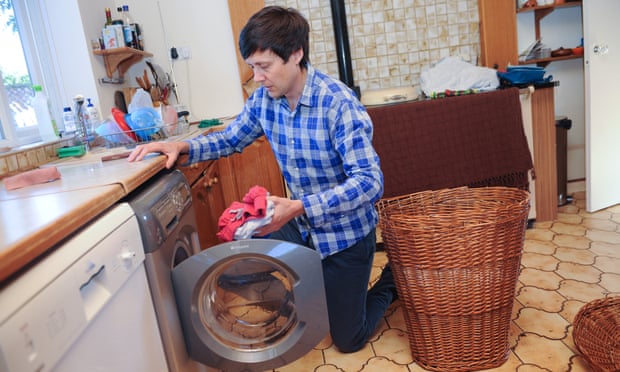
The power comes from 16 black Ja solar panels that were fitted to the roof of my home in August. Together, these panels, each the size of a coffee tabletop, have a capacity of 4kW, enough to meet the energy needs of an average family home. Today, a gloomy autumnal moment, they have generated 4.403kWh. It hardly sounds impressive – it’s enough power for a couple of loads of washing – but collectively it represents a revolution. Solar hasn’t changed my life, but it has shifted my perceptions. A little monitor on my desk tells me how much electricity I am generating. I’m acutely aware of the scarcity of energy, the rarity of unbroken sunshine and changing path of the sun. In August, rays hit my panels at 8.30am and an image of a green finger materialised on my monitor, urging me to switch on appliances. Now it doesn’t appear until 10.30am and so we delay putting on the washing machine. We have toddlers around the house all day, so solar suits us: we time the dishwasher for daylight hours and the TV tends to be on more during the day than at night. If I’m working from home, I charge laptops and phones around midday, too. Solar’s drawback is that most power is generated in daylight hours, when people tend to be at work, and there’s currently no affordable battery technology to store the energy you generate. But that energy is not wasted: it goes into the national grid, and solar owners are paid for what they produce.

A million British homes now have rooftop solar panels. The thicker panels are solar thermal and heat water. Most, some 750,000 solar PV installations, convert the sun into electricity. Solar produces 1.5% of total UK electricity, up from virtually nothing in 2010. It has proved so popular that the government wants to cut the feed-in tariff, the solar subsidy, by 87%. Since 2010, domestic and commercial solar systems have been paid by the government for every kWh they generate. I receive quarterly payments for the electricity I generate at 12.96p per kWh with another smaller payment for what the authorities estimate I return to the grid. These payments are guaranteed for 20 years. Such has been the popularity of solar that the government says it is spending too much money supporting it: from January, it is proposing to dramatically slash this subsidy for new solar installations. The Solar Trade Association has warned this could cost up to 27,000 jobs; 1,000 are already disappearing with the recent closure of four big renewable companies. Will this solar miracle be shattered? Will rooftop panels soon resemble the relics of a bygone energy age, like the enormous cooling towers of coal-fired power stations?
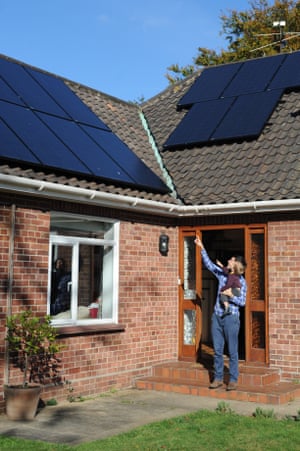
Like many people, I was persuaded to put up solar PV not by promises of a fat cheque from the government but by meeting someone who’d had panels fitted and sung their praises. In 2014, I was researching a story about REPOWERBalcombe, a community energy group created by members of the Sussex village best known for its anti-fracking protests. Tom Parker, a gardener, had panels fitted on his roof five years earlier and then volunteered to help 15 renewable projects in the neighbourhood, including his children’s school. He had watched solar systems over 20 years’ worth of running time – and none had lost a single hour of power generation. “It’s fantastically reliable, much more reliable than the National Grid,” he enthused. “It’s just churning out energy, year after year.”

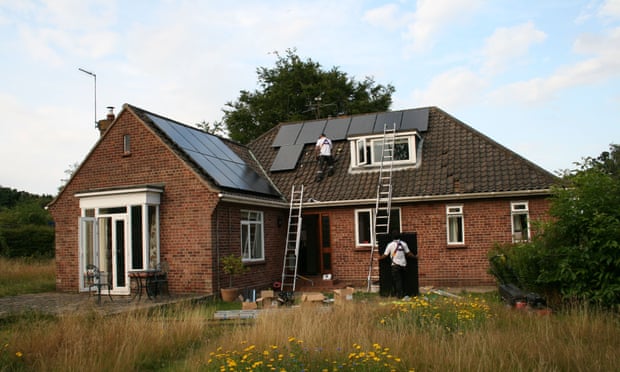
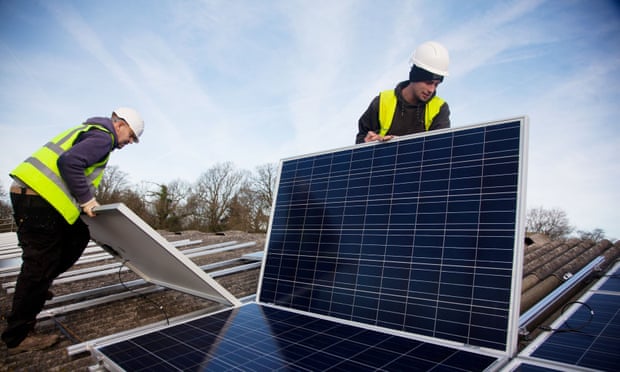
Last year, I moved to a south-facing house and this summer found a good deal for solar PV: my standard 16 panels cost £4,630 to supply and install, which was done in a day in August by an electrician and two roofers who were recent converts to solar employment. Business was brisk: they were supposed to fit two roofs each day. Business is even brisker now. Britain’s solar providers are swamped with work as people rush to get panels installed before the government introduces its planned subsidy cut. After that, with solar still a few years off “grid parity” – where a unit of solar power is as cheap as electricity produced via gas, coal or other fossil fuels – the industry will rapidly burn out. According to the Solar Trade Association, the proposed cuts will leave Britain with an annual solar spend of less than what Buckinghamshire county council is devoting to potholes this year.

I claim I would have fitted the panels without a subsidy because I want to reduce my dependence on fossil fuels; for others, solar PV is a pragmatic investment: at current prices, government subsidies and reduced electricity bills return your £5,000 in about eight years; then the subsidy – and lower bills – keep coming for the 20-year lifespan of the panels. Most experts say the panels will last longer. I have not yet noticed a rapid drop in my electricity bill, but reductions in southern England are estimated at £135 a year. If I was truly principled, perhaps I wouldn’t pocket the subsidy, but a solar meter was installed next to my electricity meter and I registered for the feed-in tariff through my energy provider. When the feed-in tariff began, in 2010, domestic early adopters were paid a whopping 43p per kWh. But they also forked out almost three times as much for their panels. My magic monitor informs me of the sun’s riches each day. My worst day so far – torrential rain – provided just 7p; the last £2 day was a month ago; will I see its like again before spring? Nevertheless, my solar is on track to generate the fitters’ predicted 3,485kW each year, which is more than my household’s annual electricity consumption. If so, the feed-in tariff will pay me £534.77 tax-free, each year.

The solar subsidy currently costs every energy billpayer £9 each year. This is the nub of the case against solar: why should poor billpayers pay for relatively affluent people like me to indulge our “green crap”? The government’s motives for cutting the subsidy were explained more pragmatically by the contractor who measured up for my panels, an old-school property surveyor who had moved into PV. The government looks like it is struggling to meet its legally binding target of renewables providing 15% of UK energy (including heating) by 2020 but such is the dramatic expansion of solar that it doesn’t want to pay millions in subsidies that cause it to exceed this target. So it is sensible to gradually reduce solar subsidy as panel costs fall: people will continue to fit solar and the industry will prosper and eventually be weaned off government support: the Solar Trade Association is begging the government to adopt an “emergency” plan to do just this. It claims it will add just £1 to annual energy bills.
When I call Leo Murray, he’s standing by a fake sun – a 10ft helium balloon filled with LED lights in Ravenscourt Park, London. The campaigns director for 10:10, a charity encouraging positive action on climate change, Murray’s lightbulb-like brightness is dimmed by the government’s desire to slash solar support. Who wouldn’t want to exceed our renewables targets, he wonders, when surveys show that solar is the most popular form of energy, with 80% support: “We explain to the public how we all contribute towards solar – it adds a couple of quid on our bills each year – and we can’t find anyone who is anti-renewable energy.”

Murray believes the government is tackling the success of solar the wrong way round. It allocated a finite sum of money and now that is almost spent, after the quicker-than-forecast uptake of solar panels, it is pulling the plug. “It’s ideologically driven. It’s coming from the Treasury. You see the looks on DECC [Department of Energy & Climate Change] officials’ faces – they don’t want to be doing this. It’s the most successful and popular climate-change policy ever implemented by the UK government – a demand-led energy policy engaging consumers in the transition to a low-energy economy.”

But why should hard-pressed billpayers subsidise expensive solar? “What really gives the lie to that argument is Hinkley [the proposed new nuclear power station]. Even staunch supporters of nuclear don’t think that is a good deal. At £24.5bn, it could be the most expensive object on earth. If you want to keep bills down, don’t do that – it’s definitely going to push bills up.” For Murray, there’s a simple way to ensure wealthy solar investors aren’t subsidised by less affluent billpayers: a solar levy could be progressively applied to bigger electricity bills. (There is a strong correlation between higher bills and higher household wealth, and there could be specific support for exceptions, such as low-income residents of energy-inefficient private rentals.)
Murray and 10:10 will continue to support volunteers in community energy. While media coverage has focused on commercial job losses, the solar cuts will also decimate community energy. Since I met Tom Parker in 2014, REPOWERBalcombe has gone from strength to strength. Funded by local people, Parker and his fellow volunteers have opened an 18kW array on a local farm and two smaller rooftop solar systems for schools. The Conservative-dominated local council this month approved their plans for a 4.8MW array which will meet all the power needs for Balcombe and neighbouring West Hoathly. But Parker is despairing at the government’s punitive approach to solar. “We demonstrated that the community hated the idea of fracking and loved the idea of solar and they are trying to prevent other communities from taking the same approach. It’s almost like we’ve been too successful.”

It’s not simply the subsidy cut: Parker lists eight major regulatory changes that have made it more difficult for community energy groups. These include making it harder for investors to obtain tax relief, changing the rules over the creation of energy co-ops and making renewable projects such as theirs pay a “climate change levy” – even though they are part of the solution, not the problem. “If someone had set out a year ago to say, ‘How can we most damage co-ops?’, I don’t think they could’ve done any more,” says Parker. As Murray puts it: “These people are volunteers, doing their best to get things off the ground and the ground keeps moving underneath them.”
REPOWERBalcombe won’t be able to grow any more, but it’s lucky to have established as many projects as it has, says Parker. Elsewhere, “it’s looking pretty dire for community energy,” admits Murray. “It won’t kill the sector dead but we won’t see any new projects coming forward.” The volunteers running community energy groups normally aspire to expand to a point where they can employ one person to run their project over its 20-year lifespan. The cuts create the prospect of volunteers being forced to manage their groups (committed to paying a return to local people who have invested in them) for 20 years themselves, unable to expand to hand over to a modestly paid professional. “That’s vindictive,” says Murray. “Presumably, it’s not meant to be.”

A botched cut in solar support may damage UK PLC, with investors fleeing such an unstable regulatory environment, as the CBI has argued, but it won’t trouble global trends. Solar currently produces 200 gigawatts around the world. Forecasts suggest this will be 1,000 in 10 years’ time but predictions, admits Ajay Gambhir, senior research fellow at the Grantham Institute, Imperial College London, have been far too pessimistic. Early 21st-century forecasts of a “US$1 per watt” price for solar panels by 2030 were reached in 2011/12. “That is a rapid cost reduction,” says Gambhir. Solar is a modular technology, so manufacturers quickly learn how to refine it when repeatedly making the same component. Chinese manufacturers will reduce costs to 35/40 cents per watt by the decade’s end, predicts Gambhir, confidently. And solar will probably be adopted in developing nations as quickly as the mobile phone in Africa: its modular character is ideal for remote countries with a limited electricity grid.

More exciting than ever-cheaper panels is affordable battery technology, which will solve my problem of generating lots of power at midday when I don’t really need it. Elon Musk of Tesla unveiled its Powerwall domestic battery to great fanfare this spring. In Britain, Powervault is selling dishwasher-sized rechargeable battery units for domestic solar for £2,800. “There’s been a lot of interest from early adopters who’d like to use more of the solar energy they generate,” says Joe Warren, managing director of Powervault. He predicts that prices could fall to £1,000 by 2020 with 50,000 UK households buying batteries.

It is not just makers who are talking up batteries. As Gambhir explains, increasing the amount of electricity storage has huge value to the National Grid because it helps balance variable supply and erratic demand (we all switch on the kettles during the World Cup final half-time). It also reduces the requirement to have big gas or coal power plants standing by to backup renewables. (Incredibly, the British government recently approved the creation of backup power stations run by diesel generators.) Batteries will also help the grid adjust to the big new challenge posed by the need to charge electric vehicles. Given these services, shouldn’t solar batteries be subsidised? “I don’t know if it’s being considered politically but from an economics of innovation perspective it makes inherent sense,” says Gambhir.

Grid parity – when solar is as cheap as gas or coal – is coming. Parity between solar and the retail price for grid electricity has already been reached in Mexico and even Germany. It will arrive in Britain in about four years, but most analysts believe that British solar won’t reach genuine parity with gas or coal (being as cheap to set up a big power station) for a decade. This will be too late to save Britain’s solar industry, if the cuts come. “Solar will get there and private money will eventually fill the gap, but it may not get there nearly as fast [without government support] and there will be more bankruptcies on the way,” says Gambhir. Murray is close to despair. To abandon solar at this moment “doesn’t make business sense and it’s terrible for the environment. The whole thing is a mess. The rest of the world is looking at us and thinking: ‘What are they doing?’”

Source by: http://www.theguardian.com/environment/2015/oct/20/solar-power-in-crisis-panels-generate-power-government-subsidy

Saturday, October 17, 2015

UK-assembled PV-heat batteries set out to ‘prove real impact on fuel poverty’


Sunamp, a Scottish manufacturer of heat batteries for domestic energy storage, including models designed to link with PV systems, has started serial production of its units from a base in the UK.

Company boss Andrew Bissell and his team revealed at the Solar Energy UK show yesterday that Sunamp’s assembly partner, Bay Solutions, is putting together Sunamp products at a rate of 100 cells a week, equating to 50 units.

While the company undoubtedly wants to go for the wider commercial market long term, the initial focus of this output will be for a community-run and privately-invested programme to assess the long-term impact on fuel poverty of using the heat storage in combination with PV on the roofs of at least 1,000 social housing developments.

After initial production began about a month ago, Bissell said, the output from Bay Solutions is at 250kWh weekly, with each heat cell holding 2.5kWh of thermal energy and each battery unit of two cells holding 5kWh. Bay Solutions had until now been making electronics boards for the batteries’ control systems but now taken on the role of producing the finished “white box” product.

The initial line of batteries will be the Sunamp PV model. As might be expected from the name, these are intended for self-consumption of PV by households. The cells use Phase Change Materials that melt and release heat when needed – melting at around 58 degrees centigrade. Sunamp claims that in contrast to a normal domestic PV system, which exports a large portion of its generated power, the heat battery allows the system user to consume as much as 80% of the PV power as converted heat energy.

Bissell has long been vocal in pointing out that in Britain, more energy is expended “in the thermal domain” as in the electrical, and claims the devices, which also work to make already installed combi boilers more efficient, can save a household up to £271 a year over the 20 year life of the PV system.

While some companies are keeping their cards close to their chests and reluctant to reveal prices ahead of full-scale launch in the UK, Sunamp has quoted prices of around £1,700 per 5kWh system – although prices exclude VAT, due to the variable rate of the tax according to whether the property it is going into is new build (0% rate), an energy efficient property (5% rate) or otherwise (20% full VAT rate). As a benchmark, Tesla’s Powerwall electrical storage battery will be sold to installers at US$3,500 (£2,270) for a 10kWh system.

Chinese investor-backed social housing trial


The first units to roll off the production line will be used in the Eastheat, programme to “prove the real impact on fuel poverty” of combining PV and energy storage in the Edinburgh region. It will be part funded by the Scottish government through the Local Energy Challenge Fund, put together by Scottish community renewable energy advisory group Local Energy Scotland.

Sunamp has partnered with two housing associations, East Lothian Housing Association and Castle Rock Edinvar. There are four other consortia in the Eastheat programme, with Sunamp and the others winning the projects through a competitive process against over 100 other candidates.

Interestingly, the project was developed before the proposal of drastic feed-in tariff (FiT) cuts in the UK. As a result of the announced cuts, the plan has been revised to maximise the number of installations from an initially planned 1,000 rooftop PV systems and 650 Sunamp heat batteries. An estimated 3,000 PV installations will be carried out instead by Eastheat’s installation partner Edison Energy. “…Due to the planned changes to the feed-in tariff the challenge was accepted to maximise the installations within the housing association properties wherever it was feasible,” Bissell told Solar Power Portal.

As the programme was enlarged, Bissell said, a Chinese investor – which Edison Energy preferred not to name at this stage – stepped in with a £10 million contribution to the project’s costs. This could also mean a ramping up of the expected 650 Sunamp system deployments.

Bissell said he personally did not know any further details of the Chinese investor.

However, he said that it was "obviously...a big investment and obviously the feed-in tariff for PV is key to it happening".

source by: http://www.solarpowerportal.co.uk/news/uk_assembled_pv_heat_batteries_in_project_to_prove_real_impact_on_fuel_pove

Wednesday, October 14, 2015

University of Kansas architecture students take solar construction into the future

October 14, 2015 Kathie Zipp

Powering old homes with solar is only half the renewable-energy equation.

Designing and building new homes that make the most of that renewable power – achieving ultra-efficient “Net Zero” construction, and beyond – is the next frontier for sustainable living.

Graduate students in the University of Kansas Department of Architecture, Design and Planning are pushing construction into the future through Studio 804, a nonprofit organization that tests their drafting-board skills against real-world challenges.
Where conventional construction ends, the Studio 804 program begins.
“If a group full of students who have never worked construction or designed and built a project can accomplish these highly sustainable buildings, it shows what the industry as a whole should be capable of,” said Taylor Pickman, now in his fifth and final year in the colloquially known “M-Arch” program. “We like to think we’re setting an example in that sense.”
Their most recent success: the East Lawrence Passive House, an innovative solar home set among the tree-lined streets of a quintessential college town, a mix of modest historic homes, and even the mansions of nineteenth century industrial tycoons.
Outside, the home was designed to fit in with the scale and aesthetics of the neighborhood, while maximizing square footage on a prominent but narrow corner lot. Cut-cedar siding offers a look familiar to the neighborhood while carrying a low carbon footprint. Generous windows maximize passive solar potential.
Inside, the home boasts a laundry list of energy-saving features. A triple-thick blanket of insulation achieves dramatic “R” values, while an advanced air barrier wrap further reduces heat loss. A low-energy HVAC system and energy-recovery ventilator supplies fresh air without energy waste, while the plumbing includes an insulated hot-water recirculation system for more efficiency still.
The home targets the rigorous standards of the LEED Platinum, Net Zero and Passive House certification programs – a trifecta for sustainable construction.
Net Zero, for instance, requires that all heating, cooling and electrical needs must be met through energy-conserving design features and onsite renewable sources.
That’s where solar comes in. The East Lawrence home features a 6kW rooftop system powered by 20 Trina modules and 10 APsystems YC500 dual-module microinverters.
Studio 804 students approached APsystems for help with the project, and the Seattle-based solar technology company offered the microinverter units as a donation.
“These students are really leading the way forward for energy-efficient design and construction,” said Jason Higginson, APsystems senior director of marketing. “As a leader in innovative solar technology, we were glad to sign on to the project and be included in this showcase home.”
Pickman said microinverters represent “a huge innovation” in the solar field, helping students meet their project goals even without real experience as solar installers.
“I have to say that those microinverters were very simple to install, very simple to work with and very simple to use,” Pickman said. “We had more trouble getting the panels up onto the roof than we ever did working with the microinverters.”

Solar works for Kansas

KU’s Studio 804 program is committed to the research and development of sustainable, affordable, and inventive building solutions, from the standards of human comfort to the nature of urban spaces.
Two education tracks are offered: a three-year Master of Architecture program for students who already hold undergraduate degrees, or a five-year program that melds both undergraduate and graduate studies and also culminates in the master’s degree.
The final year is a rigorous practicum in which students tackle all aspects of design and construction: from site selection to negotiating building and zoning codes, to working with neighborhood associations and project engineers, to pouring concrete and pounding nails.
“A lot of our projects are speculative, so we are also in charge of making sure the project gets sold,” Pickman said.
To date the studio has completed seven LEED Platinum buildings and two with Passive House certification, meeting the most rigorous environmental standards for materials and construction.
Solar has become a regular feature of Studio 804 work, Pickman said, because it is one of the most effective means of achieving onsite energy production in the Midwest.
“Solar is relatively simple and it functions relatively well with different housing configurations,” he said. “And every year the technology gets better, so every year, we can demonstrate that technology as well.”
Studio 804 produces one building per year, and they keep getting more ambitious.
Twenty years ago, the first Studio 804 project put a simple metal roof over a historic farmhouse. Two years ago, students designed and built a lecture hall and auditorium addition to Marvin Hall, a treasured, 1908-vintage engineering building on the University of Kansas campus.
Pickman said their next challenge may be achieving the WELL Building standard, which considers interior design and the ergonomics of the living spaces and fixtures – anything that will “reduce wear and tear on the human body.”
“Every year we set slightly different goals,” Pickman said, from building scale to advanced materials and construction and renewable energy techniques.
“And great architecture, or at least very good architecture,” he added. “There’s not a lot of it in Kansas.”’


source by:http://www.solarpowerworldonline.com/2015/10/university-of-kansas-architecture-students-take-solar-construction-into-the-future/

Tuesday, October 13, 2015

‘World’s Most Efficient Rooftop Solar Panel’ Revisited

World-record claims of this nature, absent actual distribution, yield and volume data, are mostly bluster and stunt specmanship.

by Eric Wesoff 
October 13, 2015

Earlier this month, SolarCity made the claim that solar panels coming off of its 100-megawatt Silevo pilot production line were setting world records for solar module efficiency as "the world’s most efficient rooftop solar panel, with a module efficiency exceeding 22 percent." A week later, Panasonic claimed the crown at 22.5 percent module efficiency.

A chart might help clear things up.

SolarCity’s panel was measured with 22.04 percent module-level efficiency by the Renewable Energy Test Center. The silicon-based bifacial PV cell combines n-type substrates, copper electrodes, thin-film passivation layers, and a tunneling oxide layer that yields high conversion efficiencies.

SolarCity claims that its module will be "the highest-volume solar panel manufactured in the Western Hemisphere." Production will begin this month at the firm's 100-megawatt pilot facility, but most of the new solar panels will be produced at SolarCity’s 1-gigawatt factory in upstate New York. Full production will be between 9,000 and 10,000 solar panels per day when the Buffalo facility hits full capacity.

SolarCity CTO Peter Rive noted that the record panel was manufactured on the company's 100-megawatt pilot production line -- the Buffalo factory won't be at full production until 2017. Rive acknowledged that the 22 percent panel is "on the high end," but also noted that a majority of panels are hitting 21.8 percent.

SunPower claims its X-Series panels are the "most efficient panel on the market today" with an efficiency of 21.5 percent. The company also says demand for its X-Series product is "extremely high," with "manufacturing volume [set] to increase more than 300 percent year-over-year." Average cell efficiency across all SunPower lines was close to 23 percent during the quarter, according to the company. A reliable source at SunPower told GTM that 22 percent efficiency panels were already coming off of its line.

A SunPower spokesperson added, "As a company that is leading in providing customers around the globe with the world’s most efficient solar panels, SunPower always welcomes others to the efficiency race. It’s great that we all agree -- efficiency matters. We’re proud that we’ve been shipping the industry’s highest-efficiency solar panels for years, and some of our customers are receiving panels with greater than 22 percent efficiency."

A source suggests that there are enough SunPower panels at the factory with greater than 22 percent efficiency to build a 10-kilowatt system, starting with panel serial number J19M20279602.

Panasonic: As covered in PV Magazine, the Panasonic panel’s 22.5 percent conversion efficiency was verified by Japan’s National Institute of Advanced Industrial Science and Technology "and builds upon the 25.6% efficiency record the company set in 2014 at cell level."

World-record claims of this nature, absent actual distribution, yield and volume data, are mostly bluster and stunt specmanship.

An anonymous source suggested, "In solar, cost is king. Energy is a commodity, after all. With [balance-of-systems] costs declining, efficiency has less leverage on total system cost."

In any case, SolarCity's pilot production line holds the title for now.

source by:https://www.greentechmedia.com/articles/read/Worlds-Most-Efficient-Rooftop-Solar-Panel-Revisited

Sunday, October 11, 2015

HERE’S HOW MANY SOLAR PANELS WE’D NEED TO PROVIDE POWER FOR THE ENTIRE PLANET


Solar energy currently is an untapped resource, only providing 0.39 percent of the energy in the US. This figure is expected to increase exponentially in the coming years with some visionaries like Elon Musk predicting solar will become the dominant energy source by 2031. So what would the earth look like if it were powered by solar panels? Land Art Generator Initiative used some fancy calculations to find out.

The folks at Land Generator used 678 quadrillion BTUs, the predicted global energy consumption in 2030, as the basis for their calculations. They converted this figure to 198,721,800,000,000 kilowatt-hours and then divided it by 400 kilowatt-hours of solar energy production per square meter of land to calculate the square footage of solar panels necessary to supply the earth with power. This 400 kilowatt-hours value was calculated based on the assumption of 20 percent solar panel efficiency, 70 percent sunshine days each year, and the measurement that 1,000 watts of solar energy hits each square meter of land on the Earth.

According to Land Art’s calculations, we would need 496,805 square kilometers or 191,817 square miles of solar panels to provide renewable power for the entire Earth. This solar panel requirement is roughly equivalent to the land mass of Spain. When looking at it globally, it is a small amount of land for a lot of energy.

Of course, this is an estimate that could change. This calculation is based current technology that is 20 percent efficient at harvesting the energy from sunlight and further assumes solar energy would be sole energy provider. If this efficiency were improved or other renewable energies were used to supply power, the amount of land mass required would shrink even further. We also wouldn’t have to take over an entire country — these panels could be spread out on the rooftops of houses and buildings around the world.

According to the US Department of Energy, the sun bombards the earth with 430 quintillion joules of energy each hour of the day. This single hour of sunlight would supply the earth with all the energy it needs for an entire year. With such an abundant energy source and so little land mass required for harvesting it, it would be shocking if we didn’t fully utilize this resource in the upcoming decades.

source by:http://www.digitaltrends.com/cool-tech/solar-panel-spain-energy/