Showing posts with label solar cells. Show all posts

Thursday, November 5, 2015

Shining more light on solar panels

Improving low concentration photovoltaics

Thermal radiation readings on panels help Joshua Pearce and his research team better understand ways to improve low-concentration photovoltaic systems.
Credit: Joshua Pearce, Michigan Tech

Solar panels are the beacon of renewable energy, yet they are not getting as much light as they could be. Joshua Pearce from Michigan Technological University and a team from Queen's University in Canada have found a way to get more sun to shine on the panels and crank up the output by 30 percent or more.

"We expend a lot of blood, sweat and tears to make solar panels as efficient as possible," Pearce says. "We work so hard to get a fraction of a percent increase on the module level; double digit returns on the systems level was relatively easy."

Such a large increase of efficiency at the system level then could greatly change how solar panels are installed, and with the economic payback, it could even mean major retrofits for existing solar farms.

"We're looking at this from a systems perspective," Pearce says, who is an associate professor of materials science and engineering and electrical and computing engineering. He explains that the research focused on the system rather than individual panels mostly because the current set up for ground-mounted solar panel arrays is "wasting space."

The iconic flat-faced solar panels installed in large-scale utility solar farms are spaced apart to prevent shading. As the sun shines on a photovoltaic system, sending electricity into the grid, a fair amount of that potential energy is lost as the light hits the ground between rows of panels. The solution is simple, says Pearce: Fill the space with a reflector to bounce sunlight back onto the panels and use the light-reflecting mathematical models of videogames and action movies to avoid temperature swings.

Source by: http://www.sciencedaily.com/releases/2015/10/151022141718.htm

Saturday, October 31, 2015

A Fix for Maximizing Energy from Solar Panels on Slanted Roofs


Researchers have shown a new way to help solar cells track the sun as it moves across the sky, which could boost a panel’s energy generation by 40 percent.

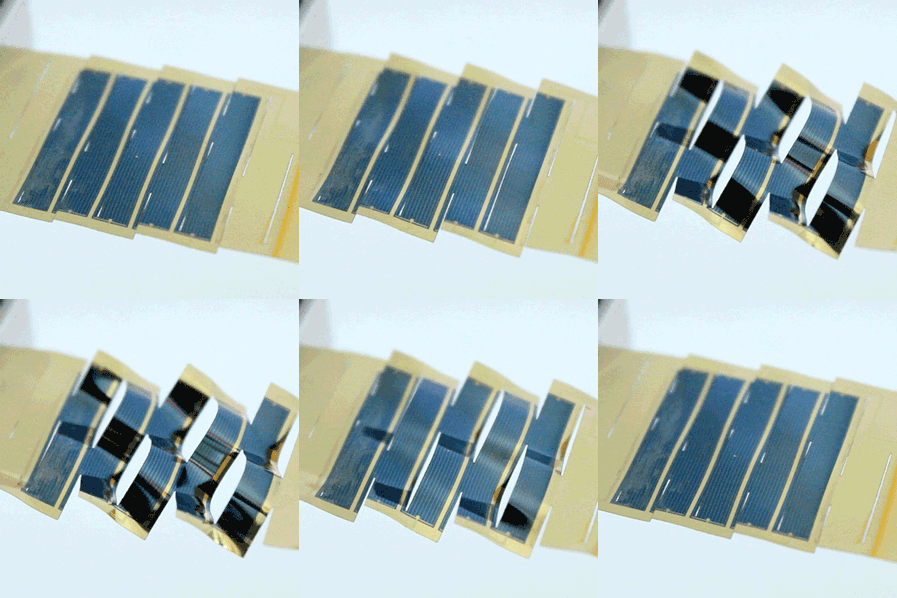
Most of the solar panels in the world sit on rooftops at a fixed angle, so they miss out on capturing energy during parts of every day. Now researchers have shown that by cutting solar cells into specific designs using kirigami, a variation of origami which entails cutting in addition to folding, they can allow the cells to track the sun’s angle without having to tilt the whole panel. This could have a substantial payoff: solar panels with tracking mechanisms can generate 20 to 40 percent more energy per year than those without trackers.

As shown in the video here, applying a specific kirigami cut creates strips in a solar cell. Pulling the two ends in opposite directions causes the strips to tilt and assume a desired angle. Crucially, the structure morphs in such a way that prevents the individual strips from casting shadows on the others, and the “waviness” of the new form does not detract from performance, says Max Shtein, a professor of materials science and engineering at the University of Michigan. Shtein led the research along with Stephen Forrest, also a professor of materials science and engineering at the University of Michigan.

The kirigami-based approach makes it possible to generate more electricity while using the same amount of semiconducting material, and accomplishes this to nearly the same degree that conventional tracking systems do, says Shtein. Today’s tracking systems, featured in only a small portion of the world’s solar power installations, are cumbersome and can be costly. And they function by tilting the whole panel. That doesn’t work on most pitched rooftop systems, which account for more than 80 percent of all installations.

The newly demonstrated device, which features flexible solar cells made of gallium arsenide, is only a proof-of-principle. Developing a technology practical enough for commercial application will take a lot more work. The researchers will likely need to come up with a system for encasing the structures to protect them against the weather and provide mechanical support, and may add electric motors to pull the cells apart at specific times during the day. “It doesn’t take much force at all,” says Shtein. He says that although the approach is best suited for thin, flexible materials, in principle it could work with “almost any kind of solar cell.”

Source by: http://www.technologyreview.com/news/541191/a-fix-for-maximizing-energy-from-solar-panels-on-slanted-roofs/