Showing posts with label energy efficiency. Show all posts

Saturday, October 31, 2015

A Fix for Maximizing Energy from Solar Panels on Slanted Roofs


Researchers have shown a new way to help solar cells track the sun as it moves across the sky, which could boost a panel’s energy generation by 40 percent.
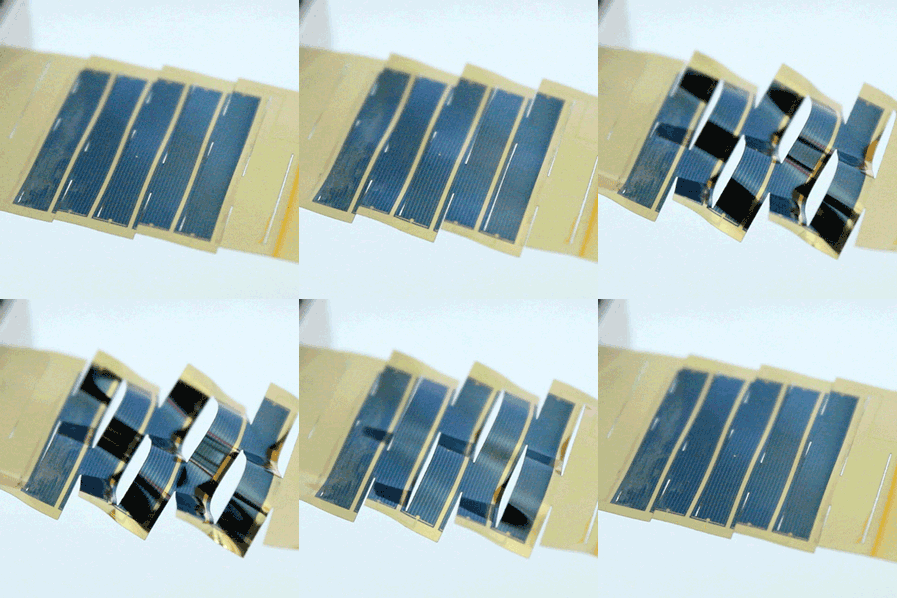
Most of the solar panels in the world sit on rooftops at a fixed angle, so they miss out on capturing energy during parts of every day. Now researchers have shown that by cutting solar cells into specific designs using kirigami, a variation of origami which entails cutting in addition to folding, they can allow the cells to track the sun’s angle without having to tilt the whole panel. This could have a substantial payoff: solar panels with tracking mechanisms can generate 20 to 40 percent more energy per year than those without trackers.

As shown in the video here, applying a specific kirigami cut creates strips in a solar cell. Pulling the two ends in opposite directions causes the strips to tilt and assume a desired angle. Crucially, the structure morphs in such a way that prevents the individual strips from casting shadows on the others, and the “waviness” of the new form does not detract from performance, says Max Shtein, a professor of materials science and engineering at the University of Michigan. Shtein led the research along with Stephen Forrest, also a professor of materials science and engineering at the University of Michigan.

The kirigami-based approach makes it possible to generate more electricity while using the same amount of semiconducting material, and accomplishes this to nearly the same degree that conventional tracking systems do, says Shtein. Today’s tracking systems, featured in only a small portion of the world’s solar power installations, are cumbersome and can be costly. And they function by tilting the whole panel. That doesn’t work on most pitched rooftop systems, which account for more than 80 percent of all installations.

The newly demonstrated device, which features flexible solar cells made of gallium arsenide, is only a proof-of-principle. Developing a technology practical enough for commercial application will take a lot more work. The researchers will likely need to come up with a system for encasing the structures to protect them against the weather and provide mechanical support, and may add electric motors to pull the cells apart at specific times during the day. “It doesn’t take much force at all,” says Shtein. He says that although the approach is best suited for thin, flexible materials, in principle it could work with “almost any kind of solar cell.”

Source by: http://www.technologyreview.com/news/541191/a-fix-for-maximizing-energy-from-solar-panels-on-slanted-roofs/

Sunday, October 18, 2015

Making Solar Panels
More Efficient


A team of researchers at Massachusetts Institute of Technology has come up with a new way to capture solar energy that makes it easier to store and be used on demand at a later time.

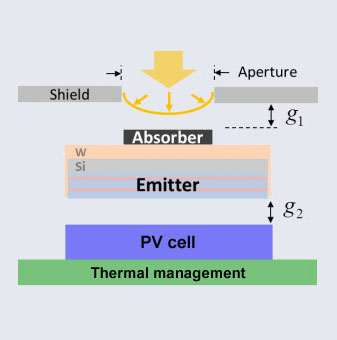
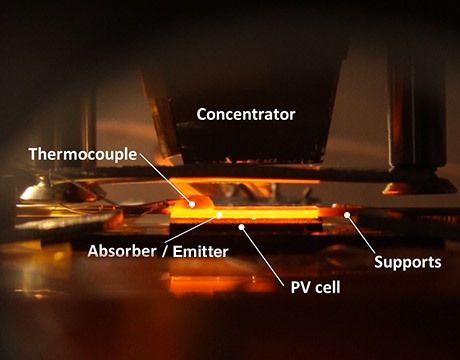
The team created a device that improves the efficiency of solar panels by using wavelengths of light that normally are wasted because they cannot be captured by conventional photovoltaic cells. In this new system, the sun heats a high-temperature material, a two-layer absorber-emitter device placed over the PV cells. The outer sunlight-facing layer, the absorber, includes an array of multi-walled carbon nanotubes that efficiently absorbs the light’s energy and turns it into heat. A bonded layer of silicon/silicon dioxide photonic crystals, the emitter, is engineered to convert the heat back into light that can then be captured by the PV cells. This allows much more of the energy in the sunlight to be turned into electricity.

This new system combines the advantages of solar photovoltaic systems, which turn sunlight directly into electricity, and solar thermal systems, beneficial for delayed use because heat is more easily stored than electricity. The basic concept has been explored for several years, according to the team.

Earlier Studies

A lot of work has been done on the theoretical design of surfaces for solar thermophotovoltaic systems (STPVs) and fabrication of single components for potential integration in these systems, says team member Andrej Lenert, an MIT graduate student who expects to be awarded his PhD in mechanical engineering this spring.

Lenert has been involved with STPV efforts at MIT ever since the university opened the Solid-State Solar Thermal Energy Conversion (S3TEC) Center in 2010, but his interest goes back even further to a radiation class. “I was drawn to this work initially because of the elegance of the concept and later because of the multi-disciplinary nature of its practical implementation,” he says. “My interest in renewable power generation stems as far back as my interest in pursuing an engineering degree.” He expects to continue research in this area after graduation.

While the earlier studies have suggested efficiencies as high as 40%, experiments remained below 1%, Lenert says. “The large discrepancy is in part due to the challenging experimental nature of spectral engineering at high temperatures. It is also in part due to fact that the overall system efficiency is highly dependent on the performance of each one of the energy conversion steps and components, just like in a conventional solar cell, except with the added spectral conversion steps in the hot absorber-emitter.”

He says the team came up with the idea for the absorber-emitter after developing a framework to identify which parts of the spectrum are most critical to the success of an STPV system. “We then tuned the spectral properties of the absorber-emitter using carbon nanotubes and silicon/silicon dioxide photonic crystals to target these properties and achieve the improved performance,” he says.

Key to the breakthrough was an understanding of the interplay between the use of structure at small scales to tune spectral properties and macroscale device design.

Lenert’s team has produced an initial test device with a measured efficiency of 3.2%, and they say with further work they expect to be able to reach 20% efficiency, enough for a commercially viable product.

Further Optimization

In their experiments using simulated sunlight, the researchers found peak efficiency came when the intensity was equivalent to a focusing system that concentrates sunlight by a factor of 750. This level of concentration is already much lower than in previous attempts at STPV systems, which concentrated sunlight by a factor of several thousand. But the MIT researchers say that after further optimization, it should be possible to get the same kind of enhancement at even lower sunlight concentrations, making the systems easier to operate.

Lenert says this is because the research center is currently working on getting even better control of the thermally-driven spectral conversion process using wavelength and angular selective surfaces. “This selectivity will lower the required level of solar concentration in two ways: Control over re-emission losses from the absorber and a more efficient TPV process that will contribute to lowering the input solar power needed to reach the same operating temperature.”

If the team achieves its goal of generating power from sunlight both efficiently and on demand from an STPV system, it could have a major impact on the way society uses solar power or at least provide another renewable option for applications when solar thermal plants or photovoltaics cannot meet the requirements, Lenert says.

Source by;https://www.asme.org/engineering-topics/articles/renewable-energy/making-solar-panels-more-efficient

Saturday, October 17, 2015

UK-assembled PV-heat batteries set out to ‘prove real impact on fuel poverty’


Sunamp, a Scottish manufacturer of heat batteries for domestic energy storage, including models designed to link with PV systems, has started serial production of its units from a base in the UK.

Company boss Andrew Bissell and his team revealed at the Solar Energy UK show yesterday that Sunamp’s assembly partner, Bay Solutions, is putting together Sunamp products at a rate of 100 cells a week, equating to 50 units.

While the company undoubtedly wants to go for the wider commercial market long term, the initial focus of this output will be for a community-run and privately-invested programme to assess the long-term impact on fuel poverty of using the heat storage in combination with PV on the roofs of at least 1,000 social housing developments.

After initial production began about a month ago, Bissell said, the output from Bay Solutions is at 250kWh weekly, with each heat cell holding 2.5kWh of thermal energy and each battery unit of two cells holding 5kWh. Bay Solutions had until now been making electronics boards for the batteries’ control systems but now taken on the role of producing the finished “white box” product.

The initial line of batteries will be the Sunamp PV model. As might be expected from the name, these are intended for self-consumption of PV by households. The cells use Phase Change Materials that melt and release heat when needed – melting at around 58 degrees centigrade. Sunamp claims that in contrast to a normal domestic PV system, which exports a large portion of its generated power, the heat battery allows the system user to consume as much as 80% of the PV power as converted heat energy.

Bissell has long been vocal in pointing out that in Britain, more energy is expended “in the thermal domain” as in the electrical, and claims the devices, which also work to make already installed combi boilers more efficient, can save a household up to £271 a year over the 20 year life of the PV system.

While some companies are keeping their cards close to their chests and reluctant to reveal prices ahead of full-scale launch in the UK, Sunamp has quoted prices of around £1,700 per 5kWh system – although prices exclude VAT, due to the variable rate of the tax according to whether the property it is going into is new build (0% rate), an energy efficient property (5% rate) or otherwise (20% full VAT rate). As a benchmark, Tesla’s Powerwall electrical storage battery will be sold to installers at US$3,500 (£2,270) for a 10kWh system.

Chinese investor-backed social housing trial


The first units to roll off the production line will be used in the Eastheat, programme to “prove the real impact on fuel poverty” of combining PV and energy storage in the Edinburgh region. It will be part funded by the Scottish government through the Local Energy Challenge Fund, put together by Scottish community renewable energy advisory group Local Energy Scotland.

Sunamp has partnered with two housing associations, East Lothian Housing Association and Castle Rock Edinvar. There are four other consortia in the Eastheat programme, with Sunamp and the others winning the projects through a competitive process against over 100 other candidates.

Interestingly, the project was developed before the proposal of drastic feed-in tariff (FiT) cuts in the UK. As a result of the announced cuts, the plan has been revised to maximise the number of installations from an initially planned 1,000 rooftop PV systems and 650 Sunamp heat batteries. An estimated 3,000 PV installations will be carried out instead by Eastheat’s installation partner Edison Energy. “…Due to the planned changes to the feed-in tariff the challenge was accepted to maximise the installations within the housing association properties wherever it was feasible,” Bissell told Solar Power Portal.

As the programme was enlarged, Bissell said, a Chinese investor – which Edison Energy preferred not to name at this stage – stepped in with a £10 million contribution to the project’s costs. This could also mean a ramping up of the expected 650 Sunamp system deployments.

Bissell said he personally did not know any further details of the Chinese investor.

However, he said that it was "obviously...a big investment and obviously the feed-in tariff for PV is key to it happening".

source by: http://www.solarpowerportal.co.uk/news/uk_assembled_pv_heat_batteries_in_project_to_prove_real_impact_on_fuel_pove