Saturday, October 17, 2015

UK-assembled PV-heat batteries set out to ‘prove real impact on fuel poverty’


Sunamp, a Scottish manufacturer of heat batteries for domestic energy storage, including models designed to link with PV systems, has started serial production of its units from a base in the UK.

Company boss Andrew Bissell and his team revealed at the Solar Energy UK show yesterday that Sunamp’s assembly partner, Bay Solutions, is putting together Sunamp products at a rate of 100 cells a week, equating to 50 units.

While the company undoubtedly wants to go for the wider commercial market long term, the initial focus of this output will be for a community-run and privately-invested programme to assess the long-term impact on fuel poverty of using the heat storage in combination with PV on the roofs of at least 1,000 social housing developments.

After initial production began about a month ago, Bissell said, the output from Bay Solutions is at 250kWh weekly, with each heat cell holding 2.5kWh of thermal energy and each battery unit of two cells holding 5kWh. Bay Solutions had until now been making electronics boards for the batteries’ control systems but now taken on the role of producing the finished “white box” product.

The initial line of batteries will be the Sunamp PV model. As might be expected from the name, these are intended for self-consumption of PV by households. The cells use Phase Change Materials that melt and release heat when needed – melting at around 58 degrees centigrade. Sunamp claims that in contrast to a normal domestic PV system, which exports a large portion of its generated power, the heat battery allows the system user to consume as much as 80% of the PV power as converted heat energy.

Bissell has long been vocal in pointing out that in Britain, more energy is expended “in the thermal domain” as in the electrical, and claims the devices, which also work to make already installed combi boilers more efficient, can save a household up to £271 a year over the 20 year life of the PV system.

While some companies are keeping their cards close to their chests and reluctant to reveal prices ahead of full-scale launch in the UK, Sunamp has quoted prices of around £1,700 per 5kWh system – although prices exclude VAT, due to the variable rate of the tax according to whether the property it is going into is new build (0% rate), an energy efficient property (5% rate) or otherwise (20% full VAT rate). As a benchmark, Tesla’s Powerwall electrical storage battery will be sold to installers at US$3,500 (£2,270) for a 10kWh system.

Chinese investor-backed social housing trial


The first units to roll off the production line will be used in the Eastheat, programme to “prove the real impact on fuel poverty” of combining PV and energy storage in the Edinburgh region. It will be part funded by the Scottish government through the Local Energy Challenge Fund, put together by Scottish community renewable energy advisory group Local Energy Scotland.

Sunamp has partnered with two housing associations, East Lothian Housing Association and Castle Rock Edinvar. There are four other consortia in the Eastheat programme, with Sunamp and the others winning the projects through a competitive process against over 100 other candidates.

Interestingly, the project was developed before the proposal of drastic feed-in tariff (FiT) cuts in the UK. As a result of the announced cuts, the plan has been revised to maximise the number of installations from an initially planned 1,000 rooftop PV systems and 650 Sunamp heat batteries. An estimated 3,000 PV installations will be carried out instead by Eastheat’s installation partner Edison Energy. “…Due to the planned changes to the feed-in tariff the challenge was accepted to maximise the installations within the housing association properties wherever it was feasible,” Bissell told Solar Power Portal.

As the programme was enlarged, Bissell said, a Chinese investor – which Edison Energy preferred not to name at this stage – stepped in with a £10 million contribution to the project’s costs. This could also mean a ramping up of the expected 650 Sunamp system deployments.

Bissell said he personally did not know any further details of the Chinese investor.

However, he said that it was "obviously...a big investment and obviously the feed-in tariff for PV is key to it happening".

source by: http://www.solarpowerportal.co.uk/news/uk_assembled_pv_heat_batteries_in_project_to_prove_real_impact_on_fuel_pove

Friday, October 16, 2015

The rush for solar power: buy now, before it's too late


This has been a bumper year for solar energy in the UK, and polls show it has become our favourite kind of power. But with drastic cuts threatened, is the industry racing off the edge of a cliff?

“The biggest challenge was the grid connection,” says Donna Clarke with satisfaction. Clarke has worked in renewables for 15 years, and developed the UK’s only biodiesel plant before moving into solar energy. When the company she now works for, Scottow Moor Solar, arrived at RAF Coltishall in May last year, there was no means to plug the 50MW (megawatts) of power they thought could be generated on the former airfield – enough to run 15,000 homes – into the electricity supply.

Nearly 18 months later, with phase one of East Anglia’s biggest solar farm completed on schedule in March, and a second phase planned, there are not one, but two connections to carry 33MW of power. One 7MW connection was bought from a developer whose planning application for two wind turbines had been refused following local objections.

Negotiating a route for the other 26MW was more complicated, as the local grid was at full capacity, but Scottow Moor founder David Fyffe managed to persuade UK Power Networks (UKPN) to support a pilot, flexible-connection scheme, meaning the power can be turned down or “curtailed” when not needed. Phase two of the project will require a third connection for a further 20MW of power – bringing the total output to 50MW, making Scottow Moor one of the UK’s biggest solar farms.

When I visited the site last month, there was a palpable sense of relief. Decommissioned military bases, with their poor infrastructure and decrepit buildings, are notoriously awkward to develop. But here in Norfolk, Scottow Moor’s backers think they’ve hit on a winning scheme – and in the nick of time.

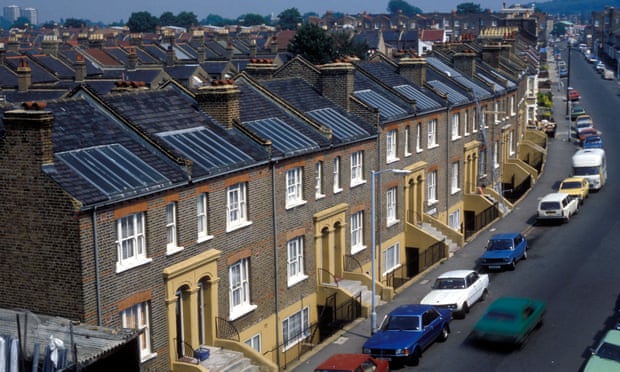
As the second phase of the Guardian’s Keep It in the Ground campaign has highlighted, solar power has gone through a remarkable period of growth since the demoralising Copenhagen climate summit in 2009: in the intervening six years, the cost of panels has fallen by 70%, with the government’s target of 750,000 domestic solar installations by 2020 reached this year. Following her promotion in May, energy secretary Amber Rudd promised to “unleash a new solar revolution”, singling out commercial rooftop developments, still a relative rarity in the UK, and perhaps thinking too of her Hastings constituents with their sun-kissed, southern roofs. But just three months later, she was announcing drastic cuts. In the next few weeks, Rudd, who used to work under chancellor George Osborne in the Treasury, will decide whether or not to reduce by almost 90% the feed-in tariff that subsidises small-scale solar installations, such as household roofs, from 1 January 2016. A consultation closes next week.

For those considering installing solar panels, the race is already on. In the weeks since Rudd’s about-turn, several companies have already gone bust.

“The rush is there. We are seeing it at many levels – large and small-scale, commercial rooftop, schools and residential,” says Reza Shaybani, chairman of the British Photovoltaic Association (BPVA). “I’m taking calls from members saying they will be doing the equivalent of eight months’ installations in the next three months, and as you can imagine, that will have an impact on safety and quality. No matter who you are, if you rush, you cut corners.”
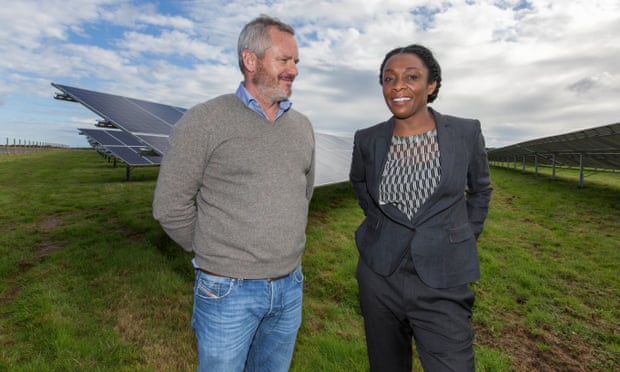
At Scottow Moor, the challenge was to get hold of and install 133,560 panels by the end of March to ensure that the project qualified for ROCs (Renewable Obligation Certificates). ROCs were one of the government’s ways of subsidising renewable energy projects greater than 5MW, until they were withdrawn from new, ground-mounted solar farms this year. The £30m project was completed in seven weeks, using 20 contractors, including three different suppliers of panels because one company could not make them quickly enough. Project manager Gareth Hawkins calls Scottow Moor “the fastest per-MW build in Europe”.

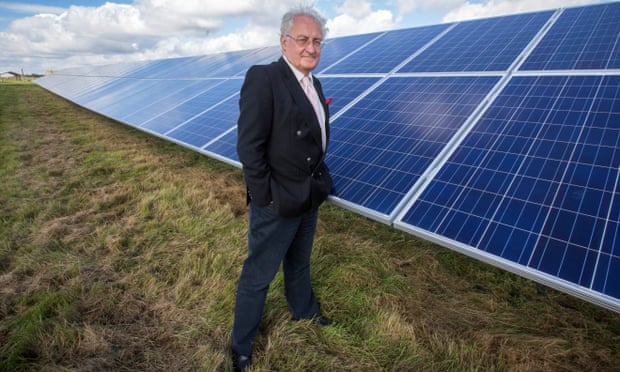
The 600-acre site, which is a conservation area covered in listed buildings with a prison for sex offenders at one edge, is owned by Norfolk county council, and when I visited council leader George Nobbs was on hand to celebrate. With his white hair, pink tie and a red handkerchief in his top pocket, Nobbs cuts a genial and jaunty figure.

“We’re one big happy family,” he says of Labour’s alliance with Liberal Democrats and Ukip, which ensures Labour and not the Conservatives leads the council, with support from the Greens. It was a Lib Dem, John Timewell, who suggested a solar farm in the first place, Nobbs says, and planning permission was granted by two Conservative-run district councils. After our interview, Nobbs gamely agrees to try to catch up with the sheep grazing under the panels for the Guardian’s photographer, so we can show how, on this flat patch of Norfolk, solar and livestock coexist (but sadly the sheep run away).
Coltishall was bought for £4m under the previous council administration three years ago, and the deal with Scottow Moor Solar means Nobbs has now made this money back. Now he and his colleagues have to attract businesses to the empty offices and aircraft hangars that have been rebranded Scottow Enterprise Park, but have so far escaped the attention of satnav: the taxi driver who took me there could find no trace of street name or postcode.

Everyone seems very pleased that TV company October Films has moved in, and plans to make a programme involving fast cars on the runway once used by Hurricanes and Spitfires and saved for reasons of nostalgia (the local village is called Badersfield, after fighter pilot Douglas Bader, who was briefly based here). More recently, says Hawkins, one of Scottow Moor’s investors used it to land a helicopter.

Whether plans to regenerate the area economically will succeed remains to be seen. There have been complications: Scottow Moor Solar has already spent more than £350,000 having the site swept for ammunition. The council would like the park to become a hub for green businesses, and phase two of the solar farm will provide electricity to the four aircraft hangars it hopes to let. But if the story so far is one of success – of co-operation between the public and private sectors; of a local farmer working with developers (the grazing arrangements don’t work with cows or horses that are too heavy and can damage equipment, so it’s sheep or nothing); of cross-party co-operation and a community with strong feelings about its military heritage brought on side through consultation – both the politicians and developers who made it happen fear there won’t be many more like it.

Partly because of the March cut-off for some subsidies, 2015 has been a bumper year for solar. Britain added more capacity last year than any other European country, and July set a new record, when on one glorious summer’s day 16% of all UK electricity was sun-powered – with around half coming from domestic rooftops, the rest from solar farms. In the same month Greg Barker, energy minister until he stood down from parliament in May, was named president of the British Photovoltaic Association (BPVA). In September, a poll for ICM found solar the most popular form of energy among voters of all parties – with 30% naming it their favourite, compared with 15% for nuclear and 13% for gas – and 78% saying the government should do more to help communities generate their own power. Solar was on a roll.

But the recent change in government policy has cast a sudden shadow. Even if the government rows back on the extreme cuts proposed, as some of its own MPs would like it to, there is no doubt subsidies will shrink, and an industry set to deliver 1GW of new solar per year will have to scale back – with domestic and small-scale rooftop installations the most obvious victims, even though policy has been to support these in preference to ground-mounted solar on agricultural land.

In the meantime, those companies that can are doing their best to make hay while the sun shines. Shaybani says the industry was prepared for a shock; orders were placed in advance and as a result, there is no shortage of modules right now. But a binge, he says, is the last thing the industry needs – especially when this looks set to be followed by a period of starvation.

Since the subsidy cuts are in the cause of saving money – higher-than-expected demand for solar having led to overspending of the budget – he argues that by stimulating a run on solar panels, the government is making things worse. While he likens previous changes in the subsidy regime to bumps in the road, the industry is now, he says, at “the edge of a cliff”.

“The redundancies we have seen are the tip of the iceberg,” he continues. “In any business, if your number of customers is limited you don’t need a big team.”

Sonia Dunlop, spokesperson for the Solar Trade Association, agrees. “The industry already had a plan to wean itself off subsidies between 2020 and 2025,” she says, “but the caveat was that we needed a stable policy framework to get us there. It’s about energy independence and investment in cheaper energy over 20-30 years. For most people it’s definitely not a green thing.”

Back in Norfolk, Clarke and Hawkins are getting stuck into phase 2 of Scottow Moor Solar’s farm. Around 43,000 more ground-mounted panels will be here by next spring, with work beginning in December.

“Speed creates challenges, especially when there are complex issues to deal with around the grid,” says Clarke, “but we think our experience means this time round there will be few surprises. Obviously, the uncertainty around policy is not helpful. But this is a project that was always going to be completed. There is a need on site for this electricity supply, and locally it’s got a lot of support.” How many similar projects will get off the ground and whether, if they do, smaller rooftop solar will be squeezed out, remains to be seen.

Source by:http://www.theguardian.com/environment/2015/oct/16/solar-power-race-is-on-renewable-energy

Thursday, October 15, 2015

Top 10 Tips for going solar, plus 10 solar energy myths busted: Clean Energy Council

Clean Energy Council’s top 10 pieces of advice for installing solar power

The CEC’s main role in Australia, in addition to being a clean energy advocacy group, is to ensure that the solar panels, inverters, and installation companies meet certain minimum safety and quality standards.

1. Be an informed consumer.
Research your options, be clear on your needs and compare quotes. (Solar Choice offers free, instant, impartial Solar Power Quote Comparisons from installers across Australia–request a price and product comparison now.)

2. Know your daily electricity consumption.
By understanding what you use, you can assess how much you would like your solar system to ggenerate, depending on your budet. Read more: What size solar power system best suits your needs?

3. Get an estimate of how much energy your system will generate.
Your contract should include an estimate of the average daily output of your system in kilowatt-hours (based on where you live and the size and position of your system). Read more: How much power will my solar system generate?

4. Check with your electricity retailer.
Never purchase a solar system without knowing what rate you will be paid for the electricity you generate and whether this will affect any hourly rates in your electricity bill. Read more: Comparing electricity prices.

5. Always use a Clean Energy Council Accredited Installer.
You can check your installer is accredited at www.solaraccreditation.com.au. (All solar PV installers in the Solar Choice network have CEC accreditation.)

6. Avoid signing up on the spot.
You should not feel pressured to sign a contract on the spot. Take the time to understand up-front costs, warranties and pay back of your solar PV system. (Solar Choice is a free and impartial brokering and advice service; we never pressure our customers to install or push them towards any one installer or product. Read more about Solar Choice’s services.)

7. Use products that meet Australian standards.
Your installer must provide proof the panels and inverters meet the standards. You can also check the product list at www.solaraccreditation.com.au.

8. Check the conditions of product warranties and work guarantees.
Know who is providing the warranty (manufacturer or importer) and how long it lasts. Read more: Solar PV system warranties.

9. Keep the documentation.
A copy of your contract is necessary to resolve any disputes down the track.

10. Remember, if it sounds too good to be true, it probably is. If you are new to the solar market and need advice, give Solar Choice a ring on 1300 78 72 73 or fill out the form to the right of this page to receive a free and instant Quote Comparison.
10 solar PV myths: Busted

Solar PV is a technology that has received a lot of negative press in the media for a number of reasons, from bona fide bad government policy to manufactured anti-renewable propaganda. The CEC has attempted to set the record straight by publishing a short pamphlet pointing out some popular myths about solar power and the facts behind them.


source bu :  http://www.solarchoice.net.au/blog/top-10-tips-for-solar-power/

Wednesday, October 14, 2015

University of Kansas architecture students take solar construction into the future

October 14, 2015 Kathie Zipp

Powering old homes with solar is only half the renewable-energy equation.

Designing and building new homes that make the most of that renewable power – achieving ultra-efficient “Net Zero” construction, and beyond – is the next frontier for sustainable living.

Graduate students in the University of Kansas Department of Architecture, Design and Planning are pushing construction into the future through Studio 804, a nonprofit organization that tests their drafting-board skills against real-world challenges.
Where conventional construction ends, the Studio 804 program begins.
“If a group full of students who have never worked construction or designed and built a project can accomplish these highly sustainable buildings, it shows what the industry as a whole should be capable of,” said Taylor Pickman, now in his fifth and final year in the colloquially known “M-Arch” program. “We like to think we’re setting an example in that sense.”
Their most recent success: the East Lawrence Passive House, an innovative solar home set among the tree-lined streets of a quintessential college town, a mix of modest historic homes, and even the mansions of nineteenth century industrial tycoons.
Outside, the home was designed to fit in with the scale and aesthetics of the neighborhood, while maximizing square footage on a prominent but narrow corner lot. Cut-cedar siding offers a look familiar to the neighborhood while carrying a low carbon footprint. Generous windows maximize passive solar potential.
Inside, the home boasts a laundry list of energy-saving features. A triple-thick blanket of insulation achieves dramatic “R” values, while an advanced air barrier wrap further reduces heat loss. A low-energy HVAC system and energy-recovery ventilator supplies fresh air without energy waste, while the plumbing includes an insulated hot-water recirculation system for more efficiency still.
The home targets the rigorous standards of the LEED Platinum, Net Zero and Passive House certification programs – a trifecta for sustainable construction.
Net Zero, for instance, requires that all heating, cooling and electrical needs must be met through energy-conserving design features and onsite renewable sources.
That’s where solar comes in. The East Lawrence home features a 6kW rooftop system powered by 20 Trina modules and 10 APsystems YC500 dual-module microinverters.
Studio 804 students approached APsystems for help with the project, and the Seattle-based solar technology company offered the microinverter units as a donation.
“These students are really leading the way forward for energy-efficient design and construction,” said Jason Higginson, APsystems senior director of marketing. “As a leader in innovative solar technology, we were glad to sign on to the project and be included in this showcase home.”
Pickman said microinverters represent “a huge innovation” in the solar field, helping students meet their project goals even without real experience as solar installers.
“I have to say that those microinverters were very simple to install, very simple to work with and very simple to use,” Pickman said. “We had more trouble getting the panels up onto the roof than we ever did working with the microinverters.”

Solar works for Kansas

KU’s Studio 804 program is committed to the research and development of sustainable, affordable, and inventive building solutions, from the standards of human comfort to the nature of urban spaces.
Two education tracks are offered: a three-year Master of Architecture program for students who already hold undergraduate degrees, or a five-year program that melds both undergraduate and graduate studies and also culminates in the master’s degree.
The final year is a rigorous practicum in which students tackle all aspects of design and construction: from site selection to negotiating building and zoning codes, to working with neighborhood associations and project engineers, to pouring concrete and pounding nails.
“A lot of our projects are speculative, so we are also in charge of making sure the project gets sold,” Pickman said.
To date the studio has completed seven LEED Platinum buildings and two with Passive House certification, meeting the most rigorous environmental standards for materials and construction.
Solar has become a regular feature of Studio 804 work, Pickman said, because it is one of the most effective means of achieving onsite energy production in the Midwest.
“Solar is relatively simple and it functions relatively well with different housing configurations,” he said. “And every year the technology gets better, so every year, we can demonstrate that technology as well.”
Studio 804 produces one building per year, and they keep getting more ambitious.
Twenty years ago, the first Studio 804 project put a simple metal roof over a historic farmhouse. Two years ago, students designed and built a lecture hall and auditorium addition to Marvin Hall, a treasured, 1908-vintage engineering building on the University of Kansas campus.
Pickman said their next challenge may be achieving the WELL Building standard, which considers interior design and the ergonomics of the living spaces and fixtures – anything that will “reduce wear and tear on the human body.”
“Every year we set slightly different goals,” Pickman said, from building scale to advanced materials and construction and renewable energy techniques.
“And great architecture, or at least very good architecture,” he added. “There’s not a lot of it in Kansas.”’


source by:http://www.solarpowerworldonline.com/2015/10/university-of-kansas-architecture-students-take-solar-construction-into-the-future/

Tuesday, October 13, 2015

‘World’s Most Efficient Rooftop Solar Panel’ Revisited

World-record claims of this nature, absent actual distribution, yield and volume data, are mostly bluster and stunt specmanship.

by Eric Wesoff 
October 13, 2015

Earlier this month, SolarCity made the claim that solar panels coming off of its 100-megawatt Silevo pilot production line were setting world records for solar module efficiency as "the world’s most efficient rooftop solar panel, with a module efficiency exceeding 22 percent." A week later, Panasonic claimed the crown at 22.5 percent module efficiency.

A chart might help clear things up.

SolarCity’s panel was measured with 22.04 percent module-level efficiency by the Renewable Energy Test Center. The silicon-based bifacial PV cell combines n-type substrates, copper electrodes, thin-film passivation layers, and a tunneling oxide layer that yields high conversion efficiencies.

SolarCity claims that its module will be "the highest-volume solar panel manufactured in the Western Hemisphere." Production will begin this month at the firm's 100-megawatt pilot facility, but most of the new solar panels will be produced at SolarCity’s 1-gigawatt factory in upstate New York. Full production will be between 9,000 and 10,000 solar panels per day when the Buffalo facility hits full capacity.

SolarCity CTO Peter Rive noted that the record panel was manufactured on the company's 100-megawatt pilot production line -- the Buffalo factory won't be at full production until 2017. Rive acknowledged that the 22 percent panel is "on the high end," but also noted that a majority of panels are hitting 21.8 percent.

SunPower claims its X-Series panels are the "most efficient panel on the market today" with an efficiency of 21.5 percent. The company also says demand for its X-Series product is "extremely high," with "manufacturing volume [set] to increase more than 300 percent year-over-year." Average cell efficiency across all SunPower lines was close to 23 percent during the quarter, according to the company. A reliable source at SunPower told GTM that 22 percent efficiency panels were already coming off of its line.

A SunPower spokesperson added, "As a company that is leading in providing customers around the globe with the world’s most efficient solar panels, SunPower always welcomes others to the efficiency race. It’s great that we all agree -- efficiency matters. We’re proud that we’ve been shipping the industry’s highest-efficiency solar panels for years, and some of our customers are receiving panels with greater than 22 percent efficiency."

A source suggests that there are enough SunPower panels at the factory with greater than 22 percent efficiency to build a 10-kilowatt system, starting with panel serial number J19M20279602.

Panasonic: As covered in PV Magazine, the Panasonic panel’s 22.5 percent conversion efficiency was verified by Japan’s National Institute of Advanced Industrial Science and Technology "and builds upon the 25.6% efficiency record the company set in 2014 at cell level."

World-record claims of this nature, absent actual distribution, yield and volume data, are mostly bluster and stunt specmanship.

An anonymous source suggested, "In solar, cost is king. Energy is a commodity, after all. With [balance-of-systems] costs declining, efficiency has less leverage on total system cost."

In any case, SolarCity's pilot production line holds the title for now.

source by:https://www.greentechmedia.com/articles/read/Worlds-Most-Efficient-Rooftop-Solar-Panel-Revisited

Monday, October 12, 2015

Solar panels on a garage near a house in Marshfield.


By Lorne Bell

Across the state, solar company sales representatives are marching door to door, offering installation contracts that seem hard to refuse: solar panels for no money down, with no maintenance, and electricity at prices significantly below those of utilities.

So, is it a good deal?

These contracts are known as power purchase agreements and they are largely responsible for the boom in residential solar panels here and across the country. Of the 189,000 residential solar units installed in the United States last year, more than 70 percent were power purchase agreements, according to Cory Honeyman, senior analyst with Boston-based GTM Research, which provides data and consulting for the green tech industry.

Power purchase agreements offer an alternative to buying and installing residential solar panels, which cost about $21,000 for a typical 6,000-killowatt-hour system, according to GTM. Instead, solar companies purchase, install, and maintain panels on customers’ homes at no cost for a contractual period of 20 to 25 years.

In return, homeowners pay the solar company for the energy produced by the panels, usually at discounts up to 25 percent lower than utility rates. The contracts also fix annual rate increases to offer predictability in the erratic energy market.

Residential solar systems can produce anywhere from 40 to 95 percent of a home’s electricity, and they can lower overall electric costs by 10 to 20 percent, says Jonathan Bass, spokesman for SolarCity Corp. of San Mateo, Calif., the nation’s biggest residential solar company. SolarCity has about 15,000 customers in Massachusetts.

For homeowners who cannot afford or do not want to pay the upfront costs of solar panels, power purchase agreements offer immediate savings and cleaner energy. Still, said Honeyman, consumers should carefully weigh their options.

“There is a lot of fine print in those contracts,” he said, “and there are important risks and considerations to keep in mind.”

The first consideration is the 20- to 25-year contract. That commitment means that if a homeowner sells his home, he must buy out the remaining years or transfer the contract to the new owner.

The balance owed when a contract ends early is based on projected solar electricity rates, average usage, and remaining time on the contract. In a typical contract charging 13 cents per kilowatt hour, for a typical home consumer 6,000 kilowatt hours a year, buying out the last 10 years could cost more than $8,000.

Solar companies say that in nearly all cases — SolarCity estimates 98 percent — homeowners transfer their contracts to the buyers.

Another consideration: the falling price of solar panels could make buying a solar power system more attractive than a power purchase agreement. The average cost to install residential solar power has plunged 73 percent since 2006, according to the Solar Energy Industries Association, a Washington trade group, and those costs are expected to decline further.

For those who can afford to buy or finance solar panels outright, owning a system can provide additional financial benefits. For one, instead of paying a solar company for the electricity produced on the homeowner’s roof, that energy is free.

Owning the panels also allows residents to reap state and federal tax credits and other incentives, which under purchase agreements, go to the solar companies. A typical $20,000, 6,000-kilowatt-hour system could generate $1,200 to $1,800 annually through the incentives — enough to cover the cost of loan payments, said Josh Mailloux, sales manager at Boston Solar of Woburn, which installed nearly 800 residential systems in Massachusetts last year. Most were purchased by homeowners.

“It’d be nice if people had some idea of what they’re giving up” with power purchase agreements, Mailloux said.

As panel prices slide, analysts expect the market share of power purchase agreements to shrink and more homeowners buy systems outright. SolarCity, which has relied almost exclusively on these agreements, recently added a loan program, called MyPower, to finance residential purchases.

Whether homeowners buy panels or enter a power purchase agreement, residential solar could face a challenge in 2017, when the 30 percent federal investment tax credit is set to expire for homeowners and fall to 10 percent for solar companies. Analysts expect residential solar installations to accelerate over the next two years as homeowners and solar companies seek to take advantage of the program before it expires.

Congress could extend the tax credits. But if lawmakers don’t, the pace of solar installations will slow, analysts said. For the time being, said Honeyman, power purchase agreements still offer a good deal for many low- and middle-income homeowners who can’t afford the upfront costs or don’t want the maintenance and other hassles of ownership.

“The case for [power purchase agreements] is still viable,” he said. “In the end, there are meaningful savings opportunities.”

Sunday, October 11, 2015

HERE’S HOW MANY SOLAR PANELS WE’D NEED TO PROVIDE POWER FOR THE ENTIRE PLANET


Solar energy currently is an untapped resource, only providing 0.39 percent of the energy in the US. This figure is expected to increase exponentially in the coming years with some visionaries like Elon Musk predicting solar will become the dominant energy source by 2031. So what would the earth look like if it were powered by solar panels? Land Art Generator Initiative used some fancy calculations to find out.

The folks at Land Generator used 678 quadrillion BTUs, the predicted global energy consumption in 2030, as the basis for their calculations. They converted this figure to 198,721,800,000,000 kilowatt-hours and then divided it by 400 kilowatt-hours of solar energy production per square meter of land to calculate the square footage of solar panels necessary to supply the earth with power. This 400 kilowatt-hours value was calculated based on the assumption of 20 percent solar panel efficiency, 70 percent sunshine days each year, and the measurement that 1,000 watts of solar energy hits each square meter of land on the Earth.

According to Land Art’s calculations, we would need 496,805 square kilometers or 191,817 square miles of solar panels to provide renewable power for the entire Earth. This solar panel requirement is roughly equivalent to the land mass of Spain. When looking at it globally, it is a small amount of land for a lot of energy.

Of course, this is an estimate that could change. This calculation is based current technology that is 20 percent efficient at harvesting the energy from sunlight and further assumes solar energy would be sole energy provider. If this efficiency were improved or other renewable energies were used to supply power, the amount of land mass required would shrink even further. We also wouldn’t have to take over an entire country — these panels could be spread out on the rooftops of houses and buildings around the world.

According to the US Department of Energy, the sun bombards the earth with 430 quintillion joules of energy each hour of the day. This single hour of sunlight would supply the earth with all the energy it needs for an entire year. With such an abundant energy source and so little land mass required for harvesting it, it would be shocking if we didn’t fully utilize this resource in the upcoming decades.

source by:http://www.digitaltrends.com/cool-tech/solar-panel-spain-energy/